Monday, February 07, 2011

How to Launch A New Blog When You Already Have a Blog You Love


When I started this blog in 2004, my impetus was the immanence of Katryna's maternity leave and the resulting fact that I was losing my platform. I needed a way to blather without being on stage, and someone (I think Meth) suggested a blog. As an avid journalist (the kind who writes 3 pages a day in a composition book, not the kind who write for a newspaper)I was used to baring my soul on the page, and I figured blogging would be a nice synthesis of my daily pages and my songwriting.

I was hooked pretty quickly. What's not to love about writing in solitude and then publishing it right away and then getting feedback in the form of comments?

Pretty soon, I saw the pitfalls. A blogger who only blogs when she feels like it doesn't usually sustain an audience. Common wisdom dictates bloggers should post at least daily. And write short posts. And respond to all comments. And stick to their subject.

I broke all these rules. What was my subject? Usually just my life, prompting a couple of readers to label me narcissistic. Yes, well.

And yet, the blog goes on. There was a period of time readers might recall, when I blogged every day. This was in 2009, when my son was about six months old and my daughter almost three. It was fun to be so connected to the "page" when I was at the same time so deeply immersed in my babies, but the directive to post every day meant that my pieces lost something in terms of length and quality. I have not mastered the art of the short post.

But now, Katryna and I are getting ready to launch a new blog. And here's the truth; after blogging for going on seven (!!!) years, I still don't know much about the art and craft. This new blog needs to be about short posts. Titled "Singing In the Kitchen," it's to be an adjunct to our book which is coming out in September (All Together Singing in the Kitchen: Creative Ways to Make and Listen to Music as a Family). Our mission is to provide young families with ideas and stories and resources to be better able to bring music into their families, to make it a wonderful source of relationship building, bonding and community building. We hope to post several times a week; to recommend other artist and books and programs; to occasionally sing a lullaby via a podcast or YouTube video. We want to start a conversation with families about the many ways they incorporate music into their lives; how it can be a source of inspiration as well as immanently practical. And yet we don't want this blog to be a big corporate affair; after all, we are the Nields. It's going to be homemade, personal, imperfect and --it is to be hoped--lovable.

And so I need your help. What are your favorite blogs? Do you read any blogs about family or music to which we should connect and reference? Do you think it's necessary for a blogger to post every day? Do you hate reading long posts? (I guess you can't hate them too much, since you are reading me.) What about the look of the blog? Should we switch from Blogger to WordPress? Any tips you can give me will be helpful!

I forgot to say that another bit of conventional wisdom I hope to flout is that one should never write two blogs at once. I hope to keep May Day Cafe alive and strong, and make Singing in the Kitchen a success, and I really want to thank all of you who read this blog for sticking with me over the years. You have taught me much. Please continue to.

Monday, January 24, 2011

Optimal Blueprint and How I Found My Tibia


Yesterday just before dinner, I came home from a weekend away and scooped up my four and a half year old daughter, kissed her, listened to her adorable recounting of the day. I cuddled her up and said, "Oh, Elle, I just love you so much. Let's be best friends forever and never ever fight."

This is a line we have been using on each other for a year and a half. But today, she just smiled as if she were the mom and I were the kid and said, "Oh, Mama, I don't really think that is possible."

I burst out laughing, hugged her again and marvelled at her maturity. We agreed that it would be OK to fight as long as we made up and forgave each other; and that that, in fact would be even better than not fighting at all. Fighting, it can be argued, can be sort of fun.

Five minutes later, she was lying on the floor having a tantrum because her dad was serving edamame for dinner and this was unacceptable. Twenty minutes after that, she was sitting in my lap gobbling up that same edamame and declaring it the best meal ever.

I spent the last weekend at the Yoga Sanctuary in Northampton, where readers of this blog know that I have been doing an Immersion in preparation for a teacher training for the past year and a half. The workshop I just attended, taught by Martin Kirk, was on anatomy. I wasn't sure what to expect--after all, anatomy has never been my strong suit. I could never remember which of the six bones in the arms and legs were which. (I think maybe I knew that the femur was the thigh bone, but humerus, tibia, ulna--whatever.) But from the moment I took my seat in that gorgeous orange room on Friday night, I knew I had come to the right place.

Martin started with a discussion of what Anusara yoga founder John Friend calls "The Divine Matrix." "There is an underlying Source that directs this dance [of creation, of life] called the Invisible Matrix. It is unseen, unmanifested energy that is you--the you that is you before you were you. That Invisible Matrix is always still there. In Anusara we are trying to line up to our individual matrix [or what is sometimes called our 'optimal blueprint'] But we are all connected to a Supreme Matrix."

I am not sure what exactly prompted me to push aside so many projects last year to focus on yoga. In many ways, it seemed a strange choice. I whittled down my coaching practice to make room for yoga classes and trainings during a year when I was under pressure to deliver a book to a publisher by a certain due date. I proceeded despite an injury to the wrist. I studied the Bhagavad Gita when I should have been blogging or writing songs. And even though the benefits of yoga for my mind and body have been abundant, I remained unclear about what inside me was so dogged in my pursuit.

And here we pause for some amusing Before and After pics.

After one month of yoga:


After 10 months of yoga:


After 15 months of yoga:


The discussion of the optimal blueprint answered my question. This was why I was here. The number one guideline for Anusara yoga teachers is to help students "Align with the Divine;" and that alignment will be different for every single individual on the planet. My job is to align with the optimal blueprint of me, and to thereby be the Nerissa-est Nerissa possible; yours is to be the Elizabeth-est Elizabeth possible, or the Fred-est Fred possible.

This is exactly what I tell my clients and the writers who write with me. The hairs on my ears and arms, not to mention the back of my neck all rose when Martin reminded us teacher trainees of this number one directive. And this: When we're injured, we ask "let me see if I can line up again." When we are off track in our lives, don't we ask ourselves the same question? What worked before? Where am I now? How to I get back to home/back to wholeness. When we find ourselves, our true path, we feel as though we have come home. When we heal, we become whole. We become holy. We return to our individual matrix.

I had a client recently who was in deep despair because he believed his whole life's work up to this point was a reaction to what his father wanted him to be rather than what his own dreams were. "And now I think that even though he was a bastard, my dad was right. I should have gone to med school. I should have become a doctor. Instead I am a failed writer who can't stop watching Grey's Anatomy. I cut off my nose to spite his face. Only it was my face."

There is a Tantric sutra that translates "Even the individual whose nature is consciousness in a contracted state embodies the entire universe in a contracted form." The laws of physics tell us that if you cut a hologram in pieces, you still retain the entire image, though it does weaken in its resolution as it gets smaller and smaller. Martin called these pieces "God molecules," and insists that "It takes pure light to project the fullness of each piece. Only you are your frequency. Refine the pure light of your own frequency and you will be luminous and unstoppable. Even the parts of you you don't like are God. It's all condensed God."

He was preaching to the choir. This is right in line (in line!) with everything in my understanding of late; that God is in the sweetness and the bitter. That everything we live through is allowed. AND that we can get closer to our own individual matrix, our optimal blueprint. Which reminds me of that old aphorism, "God loves me just the way I am and too much to let me stay this way."

But how do we refine the pure light? What is the pure light? What if we wake up on a dark snowy day with a head cold and a pipe has burst and it's negative two outside and our spouse is in a bad mood and the news on the radio makes us want to vacate the planet? And I'm not even mentioning the writer's block.

Another aphorism: "The greatest gift we can give someone is our attention." So far, this is my version of turning on the light. I give myself my own attention for starters. Instead of turning on Facebook (not that I don't love it) or the TV or reaching for a donut or a beer, I sit quietly and listen to myself whine. Sometimes this takes a long time. But it works.

When my daughter was apoplectic over her dinner selection, I just held her and let her moan. Sometimes I repeated back to her what she had shouted to let her know I heard her. Eventually she cleared up, just like the sun coming out from behind the snowfilled clouds and wiped her eyes and took a bite. And remembered she liked edamame.

I listened to my client complain about his dad and his "bad" choices for a long time too. Sometimes I repeated back what he had said to make sure he knew I was listening. I try to be like a good yoga teacher; to offer support where needed, especially when I hear a painful unnecessary thought. I offer an adjustment. I point out when the form is gorgeous and right. But mostly I give my attention. In the light of pure attention, something miraculous happens. The client begins to heal himself. Yes, I definitely point this out, encourage the healing path. But, again, like a good yoga teacher, I am not the healer. I just make the space, offer the simple instructions. Then I let him work through his own possibilities. Should he at the age of 47 go to med school? Should he become a body worker? Or maybe send his resume to a medical journal for an editorial position? My job is to listen and ask him how each of these possibilities ricochets around in his body. What feels exciting? What feels deadening? What thoughts are contributing to each feeling? It is painstaking and delicious work. And nothing is lost from the process except a bunch of used up stories that he finds were not serving him. He finds himself a free man, free to rejoice in his past, and free to make new choices for his future.

There is a phrase in Anusara, an instruction a teacher will often begin with: "Inner body bright." Martin's version of this instruction was: "Let the sun shine in your heart." I, of the notoriously slumped shoulders (which are getting much better!) notice that when I hear this instruction, I naturally lift the sides of my body as well as my rib cage. This small action not only erases the slump, it raises my spirits. I can't help smiling and feeling hopeful, even on the darkest of snowy days. And I dare say, I think this is the way we shine that light to reconstitute our God molecules into so that we, in turn, become luminous.

Here's to the return of the light.

Wednesday, January 19, 2011

Jury Duty

I have jury duty tomorrow. I am terrified I will fall asleep on the bench. That is my number one fear. Other fears:
2. I will starve to death between breakfast and lunch.
3. I will know the accused and be embarrassed for him/her.
4. I won't understand the trial.
5. They will explain it to me and I still won't understand the trial.
6. I will have to admit that I am a Yale graduate who doesn't understand the words of lawyers whose main communicating mission is to explain civil matters to folks who may or may not have graduated from eighth grade.
7. I will surreptitiously multitask while on the bench and get publicly scolded for it.
8. I will end up on a trial that takes 3 months and therefore go broke and miss HooteNanny and my writing groups.
9. Did I mention that I have to be there at 8 and not get to eat lunch till 1pm?
10. I will get there and the trial will sound absolutely fascinating--better than Dallas or West Wing or Friends or ER or Mad Men--but that I will be rejected for all the above reasons and regret it for the rest of my life.

Winter Greens Soup Recipe (From Fields of Greens)

This is an amazingly nourishing soup! Cure all that ails you. I modified it slightly, but it comes from the wonderful world of Greens, a vegetarian mecca of a restaurant in San Francisco where Tom and I went for our honeymoon. I don't have a picture of the soup, but here's a picture of me having just eaten dinner at Greens.


@ 4 cups vegetable stock
1 tbsp olive oil
1 large onion, thinly sliced, about 3 cups
salt and pepper
4 garlic cloves, finely chopped
1 cup chard stems, thinly sliced
1 medium potato, thinly sliced
1 large carrot, thinly sliced
1/4 cup dry white wine
1 bunch kale, stems removed @ 8 cups washed & packed
1 bunch green chard, stems removed @ 8 cups washed & packed
1 bunch spinach, stems removed @ 8 cups washed & packed
1 tbsp fresh lemon juice

Make the stock, or buy it. Either way, heat it up and keep warm over low heat.
Heat the olive oil in a soup pot and add the onions, 1/2 tsp salt and several pinches of pepper. Saute over medium heat until the onion is soft, 5-7 min. Then add garlic, chard stems, potatoes and carrot. Saute until the vegetables are heated through, about 5 minutes. Add 1/2 cup stock, cover the pot, and cook for about 10 minutes. When the vegetables are tender, add the white wine and simmer for 1-2 minutes until the pan is nearly dry. Stir in the kale, chard, 1 tsp salt, a few more pinches of pepper, and three cups stock.Cover the pot and cook the soup for 10-15 minutes, until chard and kale are tender. Add the spinach and cook for 3-5 min, until just wilted.

Puree the soup in a blender or food processor until smooth. Thin with a little more stock if you like--here's where I departed. I left it thick, almost like a paste. (People actually could ladle it onto a plate as opposed to a bowl and eat it like a green stew.) Season with lemon juice and more salt and pepper. We ate it with garlic bread and optional parmesan cheese. Makes 9-10 servings. From Fields Of Greens cookbook.

Monday, January 10, 2011

On The Dreaded WB (Writer's Block.)


I just finished running a writing retreat here at my house, affectionately called "Big Yellow" by the marvelous cast of writers who have been coming, practically en masse, since 2005. I love retreats. I love these people, first of all, and I love having them in my house. My kids love them too, and refer to the front room of the house as "the writers's room." They also like that whenever we have a retreat, Tom makes a batch of what he calls "crack brownies" because they are that irresistible. My kids agree. On Friday, we pulled out new candlesticks. We found our favorite Bali blue tablecloth and waved it till it settled on the dining room table. We cooked spiced lentils in butternut squash and made Tom's excellent winter greens soup from the Field Of Greens cookbook. (This soup is like drinking pure health, by the way. Ask, and I will post the recipe.)

Selfishly, I also love the opportunity to write. The method I learned for running writing groups comes from AWA--Amherst Writers and Artists-- and it demands that the leader write along with the attendees to show that the method works. In the past, I have gotten huge chunks of my books written; songs have come to me (most notably "Endless Day") and I have generally left retreats feeling refreshed and inspired.

This weekend, one of the retreatants, Ashley King, sent us all a link to a fantastic TedTalk by Dr. Brene Brown, which thoroughly primed the pump. Dr. Brown spoke movingly and sometimes humorously about her research which involves figuring out why some people have trouble with connection and others don't. It comes down to a quality she calls "wholeheartedness," and what she means by that is something we might more easily recognize as "courage." The word courage has its roots in the Latin "cor" which means "heart." ("Core" is a cognate of this word, and I love that at our core is our heart.) Courage is heartfulness, leading with the heart, with the feelings, with the emotions. In other words, courage is not so much about bravery as it is about vulnerability.

And what is more vulnerable than writing? What is more courageous, for that matter, than writing? What indeed, especially when one has what writers dread more than any affliction, even bad reviews: writer's block.

Rewind a few days. Katryna and I met with our friend Beth Spong for lunch to discuss ways in which the organization for which she is executive director--MotherWoman--and we, the Nields, could join forces. MotherWoman is a fantastic organization that creates support groups for women who have postpartum depression. Actually, their full mission is this:
MotherWoman supports and empowers mothers to create positive personal and social change through: powerful mothers groups, innovative programming to confront the feminist crisis of postpartum depression, and effective political action. Mothers face enormous challenges, including unrealistic expectations, isolation, depression and appalling family policy. By valuing and supporting mothers, everyone benefits.

Yeah. Right on! So up our alley to get behind this! And so we are and we will, but one of the tasks Beth gave me was to write "a song about motherhood which we will videotape and release on Mother's Day. Our aim is for it to go viral."

And I said, "I am up for the challenge! I will start to write it today!"

That was Wednesday.

I poked at the topic. I journaled about my own mother. I wrote a poem.

Then the retreat began. Before my writing pals arrived, I went for a walk, searching for inspiration. The sky was that kind of ice blue that you only see in January. A foreboding sky that you could almost skate on. I got lots of ideas about the song. I could see the video. I could see Katryna and me singing it. I could hear it, in a way. Oh, wait--that was the Ingrid Michaelson song I had on my iPod.

I came back and we all talked about courage, vulnerability and telling the truth about ourselves. The truth is, what keeps us from being courageous is the fear that we are not good enough as we are: that WHO we are isn't good enough, and that if the others could only see what a fraud and excellent faker we are, we'd be kicked out of the nest. This leads to more obfuscation of our true selves and therefore to more disconnection--it's a vicious cycle. But what we find out when we write together and share what we have just written is something quite different: the more truthful we are about our so-called faults--our fears, quirks, addictions--the more easily others can relate to us. While our strengths, our beauty, our kindness, our intelligence, our fashion sense might attract us to each other, all too often, it is our broken parts that connect us to each other. They seal the deal. They help us to bond. (Usually when I bond with someone it's by sharing some deeper part of myself, while the other does the same.) And it is in that connection that we begin to heal, too, or at least to laugh; and laughter is the best healing agent of all.

That was all well and good. Everyone in the group wrote brilliantly, full of courage, full of wisdom, vulnerability, exuberance, grace. Meanwhile, I took my guitar up to my bedroom with my notebooks and MacBook and wrote about seven different completely unsatisfying mother songs. (I am trying not to call them "suckitudinous.") Or at least the beginnings of suckitudinous mother songs. I was like a posterchild for everything I encourage writers not to do. I started something, then my wicked inner critic who had somehow gained access to the process, said, "That is just suckitudinous! Or, maybe it's not so bad, Maybe it's OK. But it could never go viral!" Waiting just outside my door was a parade of all the rejections I have had in my entire life, dressed for Mardi Gras, 8 weeks or so early.

I haven't had WB (writer's block) in about nine years. The last time was after I had finished recording our album Love and China and had no earthly idea where to go next. So I was caught off guard by how truly terrorizing it can be. But this time there was a new twist.

"If you were still on caffeine, you'd get the song," sneered the voice.

Oh, right! Caffeine. And thus began another parade outside my door, this one of all the New York Times articles I have read over the past ten years about how caffeine is great for brain connections, people with ADD (I am certainly a candidate) and overall heightened mental alertness. Oh, how I craved a cup of my strong black tea at that moment! I remembered back in college, my friend Leon Dewan teaching me that whenever he wanted to write a song he brewed himself a huge pot of strong Keemun tea.

What was the point of giving up caffeine if it robbed me of my muse? Was I really going to choose some principal like my health over my mission in life?

The timer went off for the fourth and final session of writing. I had something--probably nothing that would go viral, but something. I packed up my guitar and trudged down the stairs. And because, as I said, the AWA method requires the leader to show up creatively too, I started the sharing session with my bit of song. I figured at the least, I could practice courage. The retreatants were kind and supportive. And I reminded myself that it took me a year to write what is our number one song now on iTunes, the song I got a book deal for, called This Town Is Wrong, and that if it takes me that long to write a great song for mothers, so be it. It might take even longer. But I am not going to give up trying, because I really do have a lot to say.

And I am also not going to pick up caffeine. At least not today.

Instead, I am going to rely on my many WBB's (Writer's Block Busters) that have proved themselves in the past. I would love if you would, in the comments section, post your own WBBs. Here are mine:

1. Let the song go. Keep the spirit alive, but let the body go. Wait for it to come to you. It will. Trust that it will; invite it in. Treat it like a cat. Seduce it at 45 degrees.

2. Listen to lots of music. Notice that many songs you love have not gone viral.

3. Go for lots of walks and runs.

4. Every now and then, remind yourself of a nugget of the song that you like. Hum it.

5. Take lots of naps. Before you take the nap, ask the muse to help you with the song. I often wake up with a tune in my head.

6. Write a different song.

Monday, January 03, 2011

Peter Pan and Caffeine


Lately, it's Peter Pan all the time in our house. Jay insists on listening to the Mary Martin soundtrack every night before bed. Actually, technically, during bed, as we turn it on and let it play him to sleep. "Dat's my number one," he says when the song "Neverland" comes on. "Oh, ya, dat's my number one." He recently informed all of us that we should call him Peter. Also that he is from New York. He forgets the rules of the game, though. Elle wants to be referred to as "Baby Bop," but Jay will enter the room and wave casually and say, "Hi, Peter," to her.

Speaking of Neverland, in 2011, Katryna and I will turn 20. In June 1991, we played our first show for money, billed as "The Nields." That summer we got a regular gig (at the Williams Inn in Williamstown, MA) and put together a press kit (with an article from the Berkshire Eagle by Seth Rogovoy which read, "Come see the Nields. There's never any cover.") We went to music biz seminars and learned the Golden Rule for new bands: Say Yes To Everything. We did this, and it lead to us playing in the lobby of the Bushnell Theatre in Hartford, playing to attendees of a benefit. We had the idea that we could put "Bushnell" on our resume and get lots of fans. Instead we played "Closer to Fine" at the very moment a Channel 22 News camera happened to catch us in action. We also lost the local talent show to a teenage KISS cover band.

We had a lucky break and got booked at the legendary Bottom Line, recorded our first CD (66 Hoxsey Street, now out of print and doomed to stay that way, as long as Katryna and I have any say in the matter.) We got our first radio play (on WWUH in Hartford, thanks to Ed McKeon) and the rest is history. Or geometry. Or paleontology.

The rest has been a really great 20 years.

Katryna and Patty and I met early this week to talk about details of the big celebration we plan to throw for the fans who have been coming to see us lo these many years. Though I cannot divulge much of what we discussed or they will cut off my caffeine supply, I can tell you this: it's going to be remarkable. Meaning you will remark upon the happening for years to come. It will be a happening. it will be June in Northampton, and you will be there. Need I say more? OK, I will say this: We are playing the Iron Horse on Saturday night (June 11) and we have thoughts to play one song from each year we've been together. That means, unfortunately, that we will be playing material from 66 Hoxsey Street.


We all got sick at Christmas time. It wasn't the fault of the barnyard animals we serenaded. Jay threw up in Dave's face on Christmas eve, and after that, we fell like dominoes, one after another, until the only one standing was Tom. He was in such excellent health that he went ice skating several times and built Elle and Jay a double loft bunk bed.


That thing about them taking away my caffeine? was a joke. Because part of the fallout of the stomach virus was that I gave up caffeine. This was no small feat. I believe that I am hard wired to be addicted to caffeine. My whole life, BC (before Caffeine) was one long snooze. I slept through pre-school, kindergarten, elementary school and the first two years of high school. I remember many a teacher picking me up by the scruff of my neck and shaking me as I tried my hardest to use my desk as a pillow.

Then I discovered Diet Coke. I woke up! School made sense! I got good grades! I wrote long poems!

In college, I found my true love: dark black thick coffee, the kind a spoon will stand straight up in. I bought a hot pot and a filter. I lived at Willoughby's in New Haven. I became a morning person.

Sadly, I learned what all lovers of the brew learn: that caffeine stops working after a month or two, and you have to keep drinking more and more, not even to replicate your buzz, because baby, that's long gone. You have to keep drinking more to stay awake, and if you miss a cup, you're headed for the worst headache of your life.

I tried to quit. O, foolish girl! But I couldn't. Something always brought me back, usually the headache, but sometimes just the desire to feel happy. Caffeine made me happy. Like Peter wanting always to remain a little boy, I wanted always to remain up. UP! Even when it stopped working, I kept drinking it, searching for that elusive high.

Once, I gave up caffeine for Lent. Those 40 days were the longest and most dreary of my entire life. I sucked on sugarless cinnamon mints to try to extract some kind of jolt out of them. On Easter Sunday, I was in Pittsburgh, the day after a gig, on my way home. I got out of bed, threw my suitcase and guitar into my car and made a beeline for Starbucks. There I bought: a grande Americano, a venti Awake tea and a cup of decaf just for old time sake. As I drove, and drank the assorted beverages, I became a genius. Again, I wrote long poems, I had huge epiphanies about spiritual principles, I solved all the problems of each of my family members. I think I also painted in oils as I drove along Highway 80, but I'm not completely clear on that. I was pretty high.

After giving birth twice, I switched to black and green tea, also so thick a spoon will stand up in it. In order to get enough caffeine, I had three huge mugsful a day, each one with two or three teaspoons of loose leaf Peets tea (really good tea! Keemun and a fine green called Lung Ching Dragonwell.) I would have two cups in the morning, then eat lunch, make a third cup to bring up to my bed, take a nap (because I was always tired despite the tea) and revive myself with the lukewarm tea. But it doesn't work anymore. It doesn't revive me. It just makes me revved up and anxious. I have been hoping for an opportunity to quit. Who says stomach bugs don't come with unexpected bonuses?

So here I am, January 4, eight days off caffeine, titrating my daily dose of ibuprofen and feeling my own nervous system for the first time in maybe twenty seven years. For the first three days, I slept, on and off for twelve hours a day. The second three days, I needed an hour and a half nap (which, honestly, was true when I was on caffeine, see above). Then one day, I woke at 5am, went to a yoga class, had a meeting, ran for 25 minutes, picked up my kids and went shopping for dinner, fed my family, ran a writing group and went to bed at the normal hour. All by myself.

I am all here. And giving up caffeine makes me think that I can do pretty much anything. Time will tell if I can keep this resolution, but for now, nothing feels as good as my own wakefulness. I am going to miss the highs, but they may be in the past anyway. Far sweeter to face the day clear eyed and ride the waves of my own energy.

Just don't go waving your Americano under my nose. For now.

Monday, December 13, 2010

A Little Christian in my Christmas

Early Snow by Mary Oliver
"Amazed I looked
out of the window and saw
the early snow coming down casually...
...I might have joined in, there was something
that wonderful and refreshing
about what was by then a confident, white blanket

carrying out its
cheerful work, covering ruts, softening
the earth's trials, but at the same time
there was some kind of almost sorrow that fell

over me. It was the loneliness again. After all
what is Nature, it isn't
kindness, it isn't unkindness."

Sometime in the last few weeks, I have pulled my gaze up from the manuscript of the copyedits of our book, realizing that this strange year is almost over. The horribleness started about a year ago, when on Dec. 27 we learned of eleven arsons in our town and had to figure out how to explain to our kids that we might be yanking them out of their beds and throwing them out the windows at any given time. I am glad I did not know at any point in the year that it would continue to pummel the people I love (not to mention a building I love) throughout 2010. It's better not to know these things. And anyway, there was much to love in this year, much to be grateful for. One night recently we lit a candle for National Children's Memorial Day and wept with gratitude for our own healthy babies, and with sorrow for all the ones lost, all those mothers and fathers with empty arms.

I had a hard time gearing up for Christmas this year. I wanted to. But I really hate that my mother-in-law is gone. It's completely wrong. She loved Christmas; she made Christmas. I don't want to have to pretend for my kids that everything is all right, and yet, that may be the best way to get through the day. I don't want to spend money we don't have on presents my kids will play with for just a day or two and then leave in the back of a closet. And I also don't want to deal with their disappointment when they don't get the pink sparkly barrettes and the five outfits from Hanna Andersson and the Tinkerbell sneakers and the pink crazy straws. (OK, only one of my kids is lobbying me full time, but it won't be long until the younger one catches on.)


We did a show one Friday in New York City. A new fan approached me.
"There's a lot of Christianity in your music," he said, nodding.
"Yes," I agreed. "that's the tradition we grew up with. But I also love Buddha and Krishna too, if you know what I mean."
He did. "Well," he stuttered. (He was drinking a big glass of white wine. Earlier he had downed a big glass of red wine.) "It is the season of Christmas, you know. And when someone dies for our sins, it seems kind of wrong to not give them their due, don't you think?"
I smiled at him.
He looked away. "Maybe I'm getting a little heavy for a music show."
"Maybe," I said. Then: "God bless you."

I just can't get with the idea that there is one way to God. That one tradition got lucky enough to be saved and all the others are doomed. It makes no sense. This is as true for Christianity as it is for Islam or Tantra. I love the Tantric teachings I have been learning all year in my yoga training, but what I love about them are first of all how unique and wonderful their stories are and second how their truths connect to the truths I have already known and loved and understood from other traditions. As the Buddha says, "One always knows the water of the ocean because it tastes of salt. One always knows the truth because it tastes like freedom."

And yet, I do miss Jesus, especially this time of year. And so, partly to honor my Catholic mother-in-law, partly to fill a part of me that was thirsty, I set about to find some Christian in the Christmas.

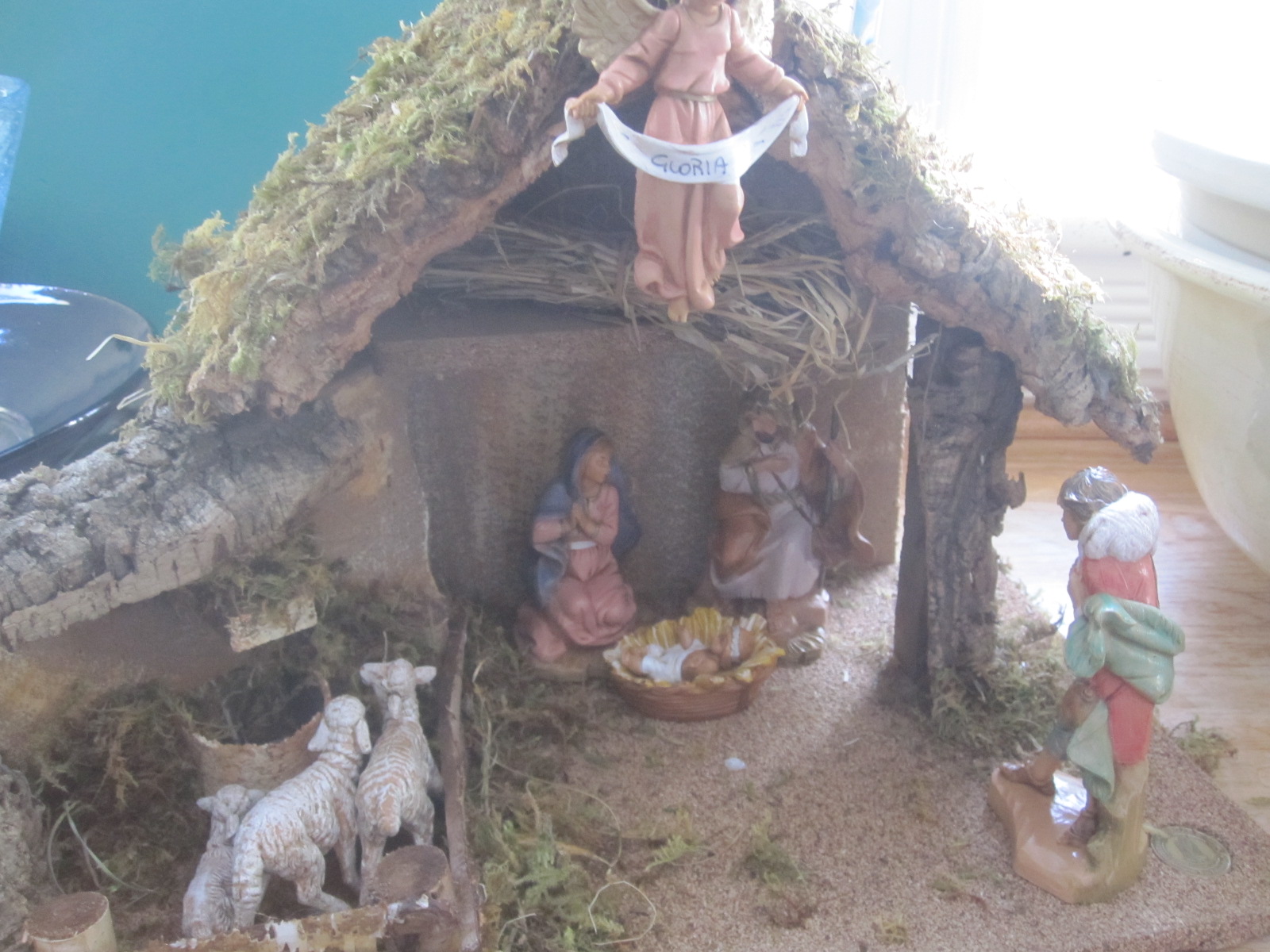
We set up the amazing rubber creche our (also Catholic) uncle Brian gave us last year. It is SUPER AWESOME! It looks like this:


And for Christmas, Elle got the three wise men, who truly rock.


I gave my dad and his sister, the Amazing Aunt Elizabeth each a copy of Stephen Mitchell's translation of the Bhagavad Gita. In turn, my father handed me a slim volume of a story he tells at Christmas: Henry Van Dyke's The Other Wise Man. This little book is a treasure in our household, though this year, I had forgotten why. When I was laid low with the inevitable stomach flu the last week in December, I picked it up and re-read it. The story goes like this:

A true Wise Man from Persia, wealthy, a healer, and astrologer, beloved in his community, becomes convinced that the stars are telling him that this is the once-in-anyone's-lifetime opportunity to seek and find the King. So he sells everything he has for three jewels: a sapphire, a ruby and a pearl which he plans to bring the baby King, in the same way his bretheren will bring gold, frankincense and myrrh. Off he goes on his horse, to meet up with the three more famous wise men. But en route, he comes across a dying man. Rather than pass him by, he tends to the sick man and heals him. But this causes him to miss his caravan. He has to sell the sapphire to purchase a camel which will allow him to traverse the desert alone.

He misses the holy family by a day. And he gives his ruby to a Roman soldier to keep him from killing a young mother and her baby. He spends the next thirty years seeking his King, only to miss him again on the night he is crucified. But during those years, he makes himself useful, healing the sick, ministering to the oppressed. He sells his pearl to save a young woman about to be sold into slavery. In each of his crossroads--at the moment when he must decide whether to keep the precious jewel for his king or to give it away to help someone in need--he agonizes.

Was it his great opportunity or his last temptation? He could not tell. One thing only was clear in the darkness of his mind––it was inevitable. And does not the inevitable come from God? (p.68).

I love how this unfolds: that even a good man, a Godly man, who sets his sites on something as selfless and pure as seeking the king would have his will thwarted. God is not a jukebox. We don't just stick in our coins and get back what we want. But even more significantly, the ways of Love are mysterious indeed. This moment of ransom marks the end of the Other Wise Man's life, and as he is dying, he finally finds what he has been seeking. He seems to the ransomed young woman who is cradling his dying body, to be in conversation with someone, asking "When did I see you hungry and gave you food? When did I see you sick and healed you?" And in response, a voice says:

"Verily I say unto thee. Inasmuch as thou hast done it unto one of the least of these my brethren, thou hast done it to me."


Totally Tantric, and totally Christian. In fact, this is what makes Christianity sing for me. This notion that we are all Jesus, and all our sisters and brothers are Jesus, and that we do good to others as we would have them do to us. That it is our responsibility to feed and clothe and heal those in need way before any other kind of worship.

Christmas ended up being sweet, fun, radiant and full of music, family and even presents well given and well received, even as we grieved our missing ones. My highlights were a Solstice party at our children's school, and our impromptu serenading of the animals at Smith Voc Ag.


This year ends. We will mark it by taking down the dry old fire hazard of a tree (grateful that this year we do not live in the daily fear of waking up to our house aflame), doing some shows at First Night, and gathering together with friends for more singing to ring in the new year properly. And my new year's resolution is to post shorter but more frequent posts.


Thursday, December 02, 2010

Those Years on the Ship


I don’t like to look into the trunk in the attic
The one behind the dirty plastic baby toys
The one with the rounded top
Manufactured for long trips on steamers during the gilded age
Rounded like the shells of mussels
Lovely but useless for a coffeetable
I don’t want to unpack it
I don’t want my kids to find it
And see that girl
Dancing in a white dress with a strange man
Not their father
Not their friend

What is it about the nature of desire
That makes it turn on itself
Chasing its own tail?

There were no steamer trunks on our ship
But every time we circled back home,
We each procured some necessary artifact
A stuffed animal
A first edition
The CD with the song that jumped from ear to ear
Like a flea
I want to love those years.
I want to squeeze the sourness out of my muscles
And memory
And feel again what it felt like
To fly
Or, short of true flight
The illusion of it.


Nerissa Nields
Nov. 16, 2010

Wednesday, December 01, 2010

Celebrating the Poetry of Others: Wallace Stevens

This is from my friend and fellow poet/songwriter Whitney Hudak. We share a love for Wallace Stevens (who inspired the Nields song "Snowman.")

Not Ideas About the Thing But the Thing Itself
-Wallace Stevens


At the earliest ending of winter,
In March, a scrawny cry from outside
Seemed like a sound in his mind.

He knew that he heard it,
A bird's cry, at daylight or before,
In the early March wind.

The sun was rising at six,
No longer a battered panache above snow...
It would have been outside.

It was not from the vast ventriloquism
Of sleep's faded papier-mache...
The sun was coming from the outside.

That scrawny cry--It was
A chorister whose c preceded the choir.
It was part of the colossal sun,

Surrounded by its choral rings,
Still far away. It was like
A new knowledge of reality.

Monday, November 29, 2010

One by Mary Oliver

Hi all,

This came from my friend Sarah this morning. Enjoy!

Nerissa

Still, what I want in my life
Is to be willing
To be dazzled-
To cast aside the weight of facts

And maybe even
To float a little
Above this difficult world.
I want to believe I am looking

Into the white fire of a great mystery.
I want to believe that the imperfections are nothing
That the light is everything-that it is more than the sum
Of each flawed blossom rising and fading. And I do.
-Mary Oliver

Sunday, November 28, 2010

I Saw Peter on the Street Today


I saw Peter on the street today
Older, with a young woman
Just like always
His hair still long but thin and grey,
Fly-away
Loose curls like clouds
Cheekbones and shoulders all angles
Small Lennon glasses, still
Looking a few feet in front of his trajectory
Just like always.
Of course I felt it
Right in the solar plexus.
I didn’t used to feel like that.
Today I cry at the drop of a hat.
(Did you know that they dropped their hats
To signal a fight?
That’s where the phrase comes from.
We dropped more than our hats.)
I wanted to stop the car, stop the trajectory
Chase after him and tell him about the hats
-Just like always-
Offer him my newest packet of information
The gift that pleased him most.
Instead I watch the young girl
Craning her slim neck up
A crescent-moon smile on her lips
Perhaps she too is making such an offering
Up to that head-in-the-clouds.
Let her.
Meanwhile, I will keep driving
Following my trajectory
Keeping the gift for you, instead.
There: you have it.
Just like always.

Nerissa Nields
Nov. 17, 2010

Wednesday, November 24, 2010

House of Bourbon (Notes for "Tomorrowland")

House of Bourbon
(“Found” poem from about 1998; revised 2010.)

What if I don’t want to be a princess?
My precious face. My beautiful face.
It’s not all I have.
Alternatively, you might see me as just another
Angry Cinderella who leaves her shoe
The way you leave a footprint:
To prove that I was there.
(I was there. I was there. I was there.)
Like a record album
Or a child.
I left that ball. True.
I walked out. Also true.
Just know the shoe you found
Was not by clumsy mistake
Nor left as a tease
but as a statement.
And after the anger
Which will fade like the red of my lips
There will remain this
My footprint.

Tuesday, November 23, 2010

I Wake a Little Off Center


I wake
A little off center
As if I am only able to inhabit
The left side of my body.
My skin itches
I am afflicted like Job
And sleepy like a bear
In late November.
Craving a cave instead of the sunlight.
The winds rise up as I set forth
Blowing debris out of their carefully raked piles
Into my face.
I raked those piles.
Is it my fault because I left them,
Foolishly thinking they would stay the night?

My only job to rake these leaves.
Give me a different job.

My heart is heavy these days
Too much death,
Too many fallen leaves.

And remains so
Until a friend calls,
Laughing
To say,
What I wouldn’t give for a rake
What I wouldn’t give for a tree.
You are so lucky.

“It is better to do your own duty
Badly than to perfectly do
Another’s”

And so I pick up the rake
Tidy the piles
Toss the fragments of leaf
Into the compost pile.

Perfectly at peace,
Even as I know
The winds could still come up again
And this time the fragments will be even smaller,
Mere dust
More painful to the eye.
Even so, Oh Lord,
I rake them again
For the love of you.

Wednesday, November 17, 2010

For Joan

I have nothing to say. I am empty. And anyway:
“Before a word is on my tongue, you know it completely, O Lord.”
So why should I write? Why should I speak?
Apple-cheeked, you were here last month, last week, yesterday
And raised your fist in victory
When the doctors said you could go home.
It’s all backwards.
You knew you were going home to die.
You welcomed it.
And we coaxed our faces into reflected, refracted smiles.
In the Bhagavad Gita
Krishna tells Arjuna, “They will all die anyway
May as well be by your hand.”
My daughter writes the alphabet over and over in purple magic marker
The words to her favorite song
She knows language is not life.
It’s an overlay at best
But it does coax the tune back.
I keep returning to my desk
To see if there is a new message from you
Your family found your account
And sends emails to us
I see your name in my inbox
The overlay of you
Still sweet as honey in tannic tea
Before a word is on my tongue
You know it completely, O lord.
And still, I would hear you speak once more.
-Nerissa Nields
Nov. 15, 2010

Saturday, November 13, 2010

What I Wonder about Prometheus


Why his liver?
That’s what I want to know.
If it had been me, I feel sure
That God would’ve taken my voice.
And it wouldn’t have been a violent desecration, either, with the mysterious restoration
In the night while the victim slept, wiped out, from the brutal operation
No, more like a borrowing—a book from the library, slyly
Returned with a different page dog eared each day.

Wednesday, November 10, 2010

Maybe God Is A Harried Parent

Maybe God is a harried parent just like, say, me.
We say, “God used to do great things,
Like create the world
And set it in motion
But now He’s this lame duck,
Just sitting back watching us destroy His creation.”

(The Deists would say this. They’re the ones that created the Enlightenment, the United States, Harvard and the New York Times not necessarily in that order.)

Anyway, what if God’s running as fast as She can
Just to keep up with our shenanigans?
Like when we take fruits and insects and birds
From one continent
And scatter them willy nilly onto another
-bananas, kudzu, sugar, starlings, eucalyptus, long horned beetles—
We put things where they don’t belong, creating unhappy couplings
We get sick and we mess with the ecosystem.
Then God has to work extra hard racing around
Trying to answer all our prayers
To get our sick selves well.
Trying to get our sick earth well, too.
Maybe God doesn’t feel so well.

My kids scatter lots of things, placing one of each into their small backpacks and purses, their own personal continents:
Tiny pieces of a ripped up pine cone
Papers covered with scotch tape and rolled up into tubes
Granola
Puzzle pieces
One card from a deck
And I race around, gathering the containers, sorting through the debris,
Returning each item to its land of origin.
Trying to make order out of the divine plan.
Wait!
Who said chaos wasn’t divine?
Who said the divine plan was ordered?
The Deists, remember. And maybe me, once.
-Nerissa Nields
November 2010

Tuesday, October 19, 2010

Iron Horse, Spanda, And the Usual


"Autumn"
Again the wind
flakes gold-leaf from the trees
and the painting darkens––
as if a thousand penitents
kissed an icon
till it thinned
back to bare wood,
without diminishment.
-Jane Hirshfield


On Saturday, Tom took Elle's training wheels off her little black and red bike, and, wobbly at first, she took off the way countless kids have done since the bicycle was invented. Her father and I wept, cheered, ran after her with our video camera and gazed at each other, our mouths dangling open, shook our heads in wonderment. Elle shrieked short little cries of glee laced with just a bit of fear, and gained skill and dexterity right before our eyes. The wobbles straightened out, and by Sunday morning, she was skidding and skidaddling all over the parking lot at her pre-school at the Bikes and Bagels Brunch, stopping to let the "little kids" scoot by in their tricycles. She'd mastered the art of balance. I kept thinking of all the similes about how picking something back up "came back to me like riding a bicycle." Now she has ridden a bicycle. She will forevermore know what that feels like.

It’s been a full and busy time. The other big event for Saturday was our annual Iron Horse show. We used to play the Iron Horse three times a year, and each time we played, we would do a Friday evening show, and two shows Saturday. We’d sell all three shows out, with lines around the block starting at 4pm. Now we have our faithful two or three who show up at load in, and we are lucky to sell out one 7pm Saturday show. Last year we didn’t sell out, and for the first time there were empty seats in the rafters. It was still one of my favorite shows––Iron Horse shows are always special, no matter what––but the week after we played, I felt a sadness that was akin to grief. I had a loss to mourn.

In the immortal words of me at 1am to my husband, “things cost things.” I think what I meant and would have said if I had had the wakefulness to be poetic was this: The world is round, and the sun can only shine on one side of it at a time. The life we had when we sold out those Iron Horse shows was the life of twenty-somethings who didn’t have mortgages or families or HooteNanny classes. Instead, we lived in Moby, our white 15 passenger van with attached trailer (Kitty Box, a window-less box on wheels full of our rotator cuff and S-I joint-destroying equipment) and played 250 shows a year all over North America. Our expenses had more to do with our personal and emotional lives than with our checkbooks (which were sparse too, 6-figure publishing and record deals notwithstanding). I loved the life of itinerant songwriter. I had the luxury of being a non-driver in the band, and so my days were full of writing and reading in the first bench seat. I matriculated at a kind of graduate school in that tiny space, reading everything I’d missed in college and honing my prose skills in composition book after composition book, amassing shelves and shelves of journals.

But man, was I lonely for a deeper, more grounded spiritual and personal experience. I wanted a home. I wanted a family. That life was great--it was all about me. I got to write, I got to perform, I got kudos galore and applause every night for my efforts. But a life that's so fully about self is out of balance; at least it was for me. I could never have articulated that at the time, but something in me yearned to give my time and energy to someone other than me, to focus on the experience of someone else. I don't mean to diminish the life of an artist, which (for me anyway) is all about looking deeply inward and drawing forth what is most true to share with others in the hopes that it will be a light to, or on, their lives. In this way, it's not intrinsically a deficit for an artist to be selfish, and I did feel justified in my narcissism. I rationalized that I was doing service by plumbing my own depths. I don't get away with that rationalization these days, at least not with my family.

We turned in the final draft of our book, All Together Singing in the Kitchen: Creative Ways to Make and Listen to Music as a Family, Monday at 3pm. We've been working on this book for over a year. And while it's been a bit intense at times, it has not been all-consuming as past projects have been. When I was on book deadline for my novel Plastic Angel, I ate, drank, slept and socialized Book 24/7 for three weeks at a time. This new book, co-written with Katryna, has been like a second or third child; it has waited patiently while other mouths were fed. It sat neglected for months while I wrote songs for our new album Ten Year Tin and for February Album Writing Month. And it lay idle as I battled wrist tendonitis and carpal tunnel syndrome and Katryna made up curricula for HooteNanny and we left our families to go to gigs. And it waited somewhere on our desktop while we transitioned our sons to pre-school and kindergarten, wrote newsletters for the band, painted pictures for Falcon Ridge, ran our retreats and writing groups, taught our students, coached our clients; and most importantly, had date nights with our husbands, or simply sat with them at the kitchen table at the end of a long day, when the kids were finally asleep, or early in the morning before they had woken up with more energy in their thirty pound bodies than I can get into mine after four double espressos. Speaking of energy, if we could have, we would have spent five times more on this book. It is not the book I would have written in my days as pseudo grad student in the back of the van. And yet, it is what it is because it, like its theme, was so immersed in our family life. It grew out of the very life that neglected it. And I can only believe it is a better book not in spite of the neglect, but because of it. That 20 something in the van would not have had any of the life experience or insights this overwhelmed and often incoherent 40 something does.

“The whole world is an ocean filled with waves, learn to float on them and don’t get caught in them. Equanimity or balance is yoga. Learn to balance yourself and you will enjoy everything” Sri Gurudev


In my yoga training, I am working with the concept of "spanda": the pulsation of the universe, which is yet another way of approaching "balance." I like to think of this expanding and contracting as the universe breathing in and out, just like each of us, like everything that's alive on the earth. I tend to forget about this basic reality. I want everything to expand, all the time. For instance, I want the stock market to go up so the money I am saving for my Dream Kitchen will increase. I am greedy. Once I allow myself to think about spending money on all the ways I want to change that most important room of our house, I can't stop. Changes lead to changes: if we knock out the back bathroom to make room for all the windows I want, we'll have to make a new bathroom somewhere else. And when we do, I want a gorgeous Mexican tiled sink in it! And I want one of those stainless steel industrial stoves with six gas burners and two ovens! And if get that, I will have to have a refrigerator and dishwasher to match!

And I want our career to grow and grow and grow and never diminish. And sometimes it feels like it always will. This weekend, we did sell out the Iron Horse show. We were joined onstage by our long-time bandmate Dave Chalfant, Katryna’s husband. He played bass with us on the road, guitar on our last five albums and has produced all but one of our CDs. He makes our music three dimensional. Tracy Grammer and Jim Henry joined us on three numbers, adding fiddle, vocals and guitar to our more country-esque tunes. And as we were loading in, our former drummer Dave Hower walked up to us on the street and we convinced him to sit in on the last few songs of the night. As always, it was my favorite show of all time. But, as I said before, it would have been even if the show hadn't sold out. Darkness has its own gifts. Sparseness too.

And of course, I already have a wonderful kitchen. Like the icon in Jane Hirshfield's poem, it's been worn down by life, most notably by the crayon scrawls all over the walls and the tea stains on the Formica. My babies are no longer babies. They are infinitely more complex than when they weighed seven pounds and needed only breast milk and even their poop smelled sweet. Now they have tantrums and ask for four different breakfasts each morning (never finishing one) and tell me they have to use the potty at the exact moment I've finally succeeding in strapping them in the detestable car seats on a cold morning when we're late to school and work.

And I get to lie with them in bed and wonder with them about God and falling leaves and blue helicopters and shyness. I get to witness Jay, just two, say, "Tank you, God for Gwammy and Gwandan." I get to listen to Elle play four different variations of "Twinkle Twinkle" on her tiny violin. I get to learn from them about balance and spanda. I get the high honor and privilege to love and serve them.

Wednesday, September 29, 2010

Iron Horse October 16, 2010

ANNUAL NIELDS IRON HORSE SHOW!!! Saturday October 16th at 7pm.


ANNUAL NIELDS IRON HORSE SHOW!!! Saturday October 16th at 7pm.

Hello friends and Happy Fall.

I must say that this is the first year in a LONG time that I have not resented the hell out of the fall. I so love summer in New England that I am always sad about it. Maybe it's the fact that we had a really long summer this year thanks to a hot June; maybe it's the fact that I got to see a majestic Moose crossing the road this week; maybe it's the fact that Monarch butterflies chose OUR front yard to lay their eggs, live their caterpillar lives and spin their crysalides(I looked that up); or maybe it is the fact that my son, having started Kindergarten, is as cheerful as I have ever known him to be. No matter why, everyone's favorite season in New England is finally also mine. Though the leaves are different than usual owing to the drought, they are no less beautiful this year. I tell you this because I am attempting to lure you here. You really should come. It's gorgeous and better than that, Nerissa and I are planning our annual Iron Horse show.

Some of our very favorite musical memories happened at the Iron Horse. Three of our cds include material recorded live in this magical space. Two of them were recorded entirely in this our beloved hometown club. We moved to this Pioneer Valley in large part because of this club. People all over the country are always telling us that they dream of making it to Northampton for a show in that hallowed room. Well, folks, now is the time. But I am guessing you are wondering about those famed musical memories. Here are my top 5:

1. Our first headline show at the Iron Horse in June of 1992. We had only played the open mic. We were as green as anyone could ever be. We were given the amazing opportunity to play a free show on that stage by the founder of the club, Jordi Herold. Nerissa made us the best press kit out of our two measly pieces of press and wrote us a fabulous bio and included photos taken of us by one of our students at the time. She sent it to every newspaper in western Massachusetts and some of them chose to print it. We plastered the town with posters and told all of our fans in Connecticut to come. We expected about 25 people if we were VERY lucky. 165 came. I will never forget the sound of their feet above our heads as we sat in the dressing room, incredulous. We played the best show of our lives up to that point and danced around the dressing room afterwards, happy, oh so happy. And then we knew that we might actually be allowed to do this thing again. After that, Jordi let us open for Cheryl Wheeler and Vance Gilbert. And a beautiful relationship was formed between the Nields and the Iron Horse.

2. One snowy night in January, we were scheduled to play two sold out shows. The first show was exciting and joyful. But during the encore, the electricity went out. We did something off mic and expected that everything would be fine in a few minutes. The audience carefully left and Eric Suher came up to us and said, "there is a line all the way down the block for the second show and the power company has no idea when they'll be able to get the power back on. What should we do?" We were a 5 piece band. And only three of us had instruments that worked without amplification. So Dave drove to Hatfield to pick up acoustic guitars at Nerissa's house. We figured we do 3-4 songs and be done. But when we started to play, we realized that it could be better than amplified sound. The room was lit by a candle on every table and several candles on the stage itself. We sang without mics, Dave Hower played drums with brushes, Dave Chalfant, David Nields and Nerissa all played acoustic guitars. Without a sound system we were not even tied to the stage. We hung off the rafters; we swung from the metal balcony; we joined the audience on the floor as we sung our hearts out. When the electricity came on halfway through the show, the audience all shouted to leave it off. We did. The Iron Horse could handle it.

3. In March of 2001, when I was 32 weeks pregnant with my first child, we took over the Iron Horse for our second set of two shows that we were recording for Live From Northampton. Recording was wonderful, but I had not accounted for how difficult it was going to be to play guitar for "Snowman"! We worked it out, but I am guessing that the Dec version of "Snowman" was the one included on the live CD. The CD ("Live From Northampton") was the last recording the 5 piece Nields ever recorded. It remains our ode to our favorite club in the world, filled with the best fans on the planet.

4. On a terrible day in 1995, we did what we thought might be our last Iron Horse show. Jordi Herold had sold his beloved club to Jo and Craig, two very nice people who, that day, told us they could no longer afford to run it. Everyone said that whoever bought it would turn it into a run-of-the-mill rock club with nothing but cover bands. But then Eric Suher bought it and protected it and preserved the amazing musical treasure that it remains today. This is one of my favorite musical memories because I was so very grateful that night for what the club had given me- both as a performer and as a member of the audience. This club is a community center, and we are so lucky to have it in our Valley.

5. Then there are the times when we were in the audience: Michelle Shocked in 1993 from the third row, Fleming and John- one of the coolest bands EVER. Google them. You will not regret it, Moxy Fruvous so many times, but particularly one night when a couple got engaged. We saw The Story in 1992 playing on a stage crowded by the set for Daniel Lanois; Ollabelle in 2003--one of Nerissa and Tom's very first dates; Ben Demerath and Dave Chalfant and Tracy Grammer and Jim Henry- Dave sang! The Roches- from the balcony. I almost died when they did "Hammond Song;" Suzanne VEga when Nerissa was a couple of days away from giving birth to Johnny. Northern Lights when Katryna was a couple of hours away from giving birth to William... and so many more, too many to count. This place is like no other. Come sit in the audience and sing with us. It won't happen again for a WHOLE YEAR!


So there. Come to our show. We like you and we want you to be there!


Love, Katryna & Nerissa

Wednesday, September 15, 2010

Bhagavad Gita #1


Our editor has our book, and so I am sitting on my hands. To pass the time, I am reading the Bhagavad Gita. Just for fun. OK, also because it's part of my yoga teacher training, but details.

I love this text. I love the central idea, which seems to me to be stated perfectly in Chapter 2:

You have a right to your actions,
but never to your actions' fruits.
Act for the action's sake.
And do not be attached to inaction.

Self-possessed, resolute, act
without any thought of results
open to success or failure. (2.47-48 translation by Stephen Mitchell)

Such a wonderful ideal for writers and songwriters, performers, mothers, lovers–all of us. And how hard it is to live this way! Open to success or failure? Are you kidding me?

And yet, when one begins a novel, how else can one be? Who has been able to start any endeavor without the knowledge that failure is at least a possibility. I certainly felt this way when I tried to get pregnant, and I have felt this way every single time I sit down to write a song. Most of the work I do as a writer is in silencing the voices that tell me how doomed my nascent writing is.

The Bhagavad Gita is one of the central poems in the Mahabarata, a sacred Indian text written sometime between the 5th Century B.C.E and the first century CE. It may have been an independent poem inserted within the greater work; at any rate, its title means "Song of the Blessed One," and it takes place on the battlefield of Kuru at the beginning of a war between two clans, the Pandavas (good guys, led by Arjuna) and the Kauravas, evil cousins. But Arjuna pauses right before he is to enter the field, stricken with doubt and confusion. Why should he kill his relatives? He drops his weapons and his charioteer, Krishna, who happens to be god incarnate, begins a dialogue that turns into a meditation on the nature of life, death, duty, nonattachment, love, and yoga, which is defined here as "skill in action."

Renunciation of action is giving up, says Krisha; doing what Arjuna wants to do, which seems like humble peacemaking but is really unskillful inaction, shirking duty, fleeing his dharma. (I won't at this point go into why this is so––peacemakers, suspend your disbelief; stay with me!)

Renunciation of the fruits of our actions, on the other hand, is not only the path to enlightenment: it is nirvana itself, in the moments in which we let go. Gandhi says (referring to the Gita), that this kind of renunciation of our fruits "is the central sun around which devotion, knowledge, and the rest revolve like planets."

Better to do one’s own dharma badly than to do someone else’s perfectly (3.35)is another way the Gita states its theme. I can only be Nerissa. I can’t be my yoga teacher, or Joni Mitchell, or my grandmother. I can try to be someone other than me, and in some ways I might seem like I am succeeding, but ultimately I will be cheating myself and the world out of the particular image of God that is in me and only in me, not to mention passing on a lie. And that dharma, whatever it might be, might not please me all the time, just as Arjuna does not want to fight and is full of conflict. I might wish to practice asana like my teacher; to write songs that reach millions of people like Joni Mitchell; or be perfectly kind and never lose my temper like my grandmother, but this is not who I am. Or it might be, but for me to cling to the outcome of my actions and have in mind specific ideas of what the outcomes should look like is wrong thinking. However, I can take disciplined action to practice my asanas, practice my songwriting, practice kindness and compassion. This is yoga: skill in action. Or, put another way, practice.

Our Suzuki violin teacher Emily Greene said to Elle yesterday, "Elle, do you know why we practice?"
Elle: No.
Emily: To make it easier.

Douglas Brooks writes, “How we experience ourselves in the act determines our experience of bondage or freedom.” (p. 64 of Poised for Grace) And so when I practice asana, it’s about the moment that I come into the pose, working to align with the optimal blueprint of my own body—letting go of how “perfect” the final pose is. Was I aligned? That is what matters. Moreover, there are ALWAYS actions to take, even when the actions can seem completely fruitless. Today Jay drew with marker all over our hardwood hall floors. This was just after both he and Elle completely trashed the house right after I’d spent about an hour tidying it up. I got mad, thinking, “I do all this work for nothing! Like Sisyphus!” But life is about cleaning up messes. Life is messy. Generating new life is extra messy. We will always have messes, just as we will always have the Brahman and the untouchables. Jesus said, "The poor will always be with you," and I would argue that the yoga is in how we treat them; how we keep giving even when it feels fruitless. Besides, it is good for our souls to give. It helps me remember (as I am in the act of giving) that that poor person is me, just as the Brahman is me. When I clean the marker off the wood floor with a heart full of gratitude, seeing the situation for what it REALLY is (that I am so so blessed to have two creative, lovely kids, not to mention a house with gorgeous wood floors, arms to scrub with, sponges to scrub with, knees that bend) I am in heaven; I have reached nirvana.

Ch. 6 verse 2
Know that right action itself
Is renunciation, Arjuna;
In the yoga of action, you first
Renounce your own selfish will.

Abhinavagupta’s wonderful analogy about the gambler—that it is easy for a gambler while gambling to feel like a king, but this doesn’t make him one—is perfectly stated for this point. I have many desires that are not wholesome, and usually they fall into the category of wanting to do nothing when doing something would be preferable. I want to sleep a little longer instead of getting up to mediate. I want to keep reading the newspaper when the phone rings and I can see that it’s a friend who might need me. I want to keep eating when to do so would mean less food for others, and more than my body needs.

Renouncing my “own selfish will” is crucial for me to have a good day, fulfill my dharma, align with the divine, my optimal blueprint; be useful to others. To align myself with God’s will is my daily aim. In fact, I begin each day by asking for my thinking to be divorced from self-seeking motives. I begin each day by turning my will over to the care of the Self (God, for me, but the God who is in all of us) and not to my self. I can easily delude myself into thinking that some action I would like to take is a good one if I don’t take the time to center myself.

Over and over again, I find that when I let go of my own will and surrender to the greater will, what I know intuitively is God’s will for me, I grow, I have a great time, I feel of service, I feel useful, I feel like an arrow who is hitting its mark, AND I feel like the archer. I see much farther, the way one gets a much clearer lay of the land when one climbs to a higher vista on a mountain. Just to be clear, I don’t always know what the divine will is, but usually I can tell because it’s What Is rather than What I Wish It Would Be! It's my kids drawing on my floors with Sharpie rather than filling the empty recycled journals with clever drawings and wobbly letters that spell out their names.

Wednesday, September 01, 2010

Nerissa on Channel 22 Mass Appeal 9.1.10


ONLINE INTERVIEW QUESTIONS:
Ashley: What do you do as a certified Martha Beck Life Coach?

Nerissa: I help people uncover their inborn joy and creativity, mostly through writing, but also through learning how to listen to their bodies, talking, and recognizing limiting beliefs.

Ashley: What is Writing it up in the garden?

Nerissa: Writing it Up in the Garden is the name of my weekly writing workshops and occasional weekend retreats. I take groups of up to six writers (twelve for retreats) and create a safe and comfortable environment in which to write. I start writers off with a prompt, and we write for about 50 minutes. Then we re-group and share what has been written with non-prescriptive, supportive feedback (we look to what is good in the piece. We save the "pruning" for a later date.)

Ashley: What are some ways we can create containers for time and space to do practices, such as writing?

Nerissa:
-do it first thing in the morning, or some other time when you know you won't be distracted. Best to find a consistent time (or times) of day to write, and to do it daily.
-write with a timer
-write for a limited number of pages
-write with a buddy
-write in a group
-make dates with yourself and write in coffeeshops
-hire a coach!
-notice your biorhythms and write when you have energy

Ashley: How is writing a practice, just as yoga is a practice?

Nerissa: There is no end game in either, though we can be tricked into thinking otherwise. We can THINK the goal is publication (for writing) or enlightenment/fitness for yoga. But the real goods are in the practice itself. In both, we are present, in the moment, for our experience. While it's been wonderful to have my books published, my songs performed by others, checks in the mail for the books and CDs I sell, or even praise for my work, nothing can compare to the sweetness I have felt when I come up with THAT PHRASE, or THAT NOTE. Actually, nothing can compare to the relationship I have built with myself over time, in that sacred space I make and maintain for writing (or yoga). I show up for myself. And what I know now is that I am a trustworthy person because of that.

Ashley: What are some ways we can be at ease with what we have?

Nerissa: Practice gratitude! Enumerate the good things we have, especially when we want a particular something else. Notice how great the kitchen we do have is when we start fantasizing about someone else's. Notice how healthy and strong your own body is when you start to wish you had thinner thighs. Notice how well your car runs when you start complaining about how shabby it is. I have my clients do this in writing.

Also, it helps to clean up and declutter. Often we hate what we have because we're not really taking care of it, e.g. paying attention to it. Or we actually have too much stuff, and what we really want is empty space.

Ashley: Who can benefit from coaching?

Nerissa: People who are ready to tell the truth to themselves about themselves. People who want to grow.

7. How is life like a couch? AH! I love this. I believe the universe is ultimately waiting for us to cry "Uncle" and flop down on our bellies on a nice, soft couch. It's when we admit our weaknesses that we can start to get well. Also, it's been my experience that everything goes better when we take little breaks and rest. Couches are better than beds for resting (because in a bed you could fall asleep for TOO long.) And I think there's a kindness to the universe, to Reality, that is not unlike a couch. And a couch, unlike a chair, sits two. Coaching is all about keeping company.