Thursday, August 26, 2010

Break in the Fast


I have been on a blogging fast because the deadline for our book is Sept. 7. And I need every hour. But I couldn't resist posting this.

We were on our way to the Electronics store finally to get our tuner fixed. It's been seven years of static. It was time. As I turned right from the corner of King Street onto Damon Road, Elle spied a construction man smoking a cigarette. He was ageless; sandy grayish hair, a slouched aspect, no affect in his face which seemed somehow as though it had collapsed, folded in on itself. He stared into the middle distance as if he were a statue.

"Mama," she said pointing at his hand. "What's that?"

Let me say right here, that I am not proud of my response. I was on edge anyway, for reasons I would happily go into if I weren't on book deadline. Suffice it to say, I was doing my thing: trying to control my kids through scare tactics. And so I said something mild like this.

"That's a cigarette. He's smoking. He's going to die because of that."

"Really?"

"Really. It's deadly. It's a very stupid thing to do."

Silence.

"How will he die?"

"He'll get lung cancer."

"What's that?"

"Well, it's this horrible disease where your lungs start to turn black and disintegrate and soon you can't breathe anymore."

At this point, I was feeling the first twinges of remorse for my extreme fear tactics, and I softened a bit. "You know where your lungs are, Elle?"

She nodded and pointed to her chest.

"They're like two big balloons. They stretch out," I breathed to demonstrate––"and in." Perhaps because of the breathing, I calmed down a bit myself. "People don't always die, actually. And if they stop, they can be completely fine again." And I told her a story about a friend of ours who quit smoking and is, evidently, not dead.

We dropped off the tuner and turned around, drove home a bit more slowly.

"I wonder if he's dead yet," Elle mused.

"Who?"

"That smoking guy."

"Oh, sweetie! He won't die right away!" Now I was really remorseful. "Let's pray really hard that he stops in time."

We both scrunched up our faces. "Maybe he'll stop today!" Elle said.

"Let's hope!" I agreed.

We arrived at the intersection. No man.

"He's dead, Mama," said Elle, pointing at the space where the man had stood. "See?"

"No," I said, anxiously scanning the horizons. "He just went somewhere. He's not dead, sweetie. Really. It doesn't happen like that." I was about to go into a long pontification about how the things we want that aren't good for us are really hard to let go of, when she spied him across the street.

"Mama! Look! He's alive! And he doesn't have a cigarette! He's quit! He's going to live!"

"Hooray!" I said. We both waved at the man.

"Mama," Elle said. "Roll my window down." This I did, though I feared a repeat of my diatribe in four-year-old vernacular. I shouldn't have worried. She called out, "Bye!" and waved. He turned his folded up face in our direction, and I swear I saw a flicker of presence there that was absent before.

Wednesday, July 21, 2010

Death and Birth in Three Days


Last Wednesday, my mother flew up to Boston and met up with Katryna and me and our sister Abigail who lives near the city. We were manifesting a dream my mother had articulated sometime last year: wouldn't it be fun to have a mother/daughter night out? Abigail, the most planful of the four of us, had gotten us to put a date into our calendars––urged on by the fact that Abigail was due to deliver her third baby on July 25. So the four of us showed up in Boston on Bastille Day, our husbands and kids back at home. Katryna and I met with our editor at Shambhala and then put the book on hold to meet our mother and sister at the Museum of Fine Arts on an unseasonally cool rainy day. We stepped into the first exhibit and almost in one voice, murmured "Grandmummy!" as we gazed at some lithographs by one of her favorite artists: Toulouse-Lautrec.

Grandmummy, AKA Margaret Brett Tenney, was born in 1907 in her parents' apartment in New York City. She spoke French before English and studied at the Sorbonne in Paris in the twenties. She loved modern art, and we three granddaughters grew up being taken to art museums. I didn't think this was unusual until reflecting on it recently; didn't all children know the difference between a Giacometti and a Rodin? She stayed single until the age of 35, running a hat shop called The Mad Hatter (in Manhattan) and acting with a troupe called the Snarks. At 36 she had my mother. At 40 she gave birth to my aunt Sarah. Her husband died when she was sixty, and she began to travel all over the world, visiting communist China and the Soviet Union in the seventies as well as South America, Africa and many parts of Europe, especially her beloved Paris where she maintained many friendships. She spoke too many languages for me to count; she learned Spanish in her seventies. She discovered acupuncture while visiting China in 1972; she took up yoga at the age of sixty-five, and we grew up witnessing her morning ritual: sun salutations, a headstand and then a breakfast of yogurt and granola.

She just celebrated her 103rd birthday on July first. She has been senile for the past ten years, unable to walk unassisted and needing round the clock care. We came to visit her regularly, introducing her to her six great grandchildren, playing drums with her, singing to her. We'd had some calls recently from her caregivers letting us know that she seemed to be fading, refusing to eat and drink. So when the four of us stood in the MFA looking at the Toulouse Lautrec lithos, I had the thought, "Grandmummy's dying. Grandmummy's here."

The next morning, I woke at six, my mother sleeping in the same bed as me, Katryna on the fold-out couch in our suite in the Park Plaza. I went for a run around the Boston Commons, wished Elle and Jay were with me to see the swan boats and the Make Way For Duckling bronzes. My mother called my iPhone as I was coming up the elevator to let me know that Jean, my grandmother's caregiver, had called to say that this might be my grandmother's last day. Our aunt Sarah happens to live in Cambridge, so my mother called her right away and the two of them made plans to drive to New York together. We hugged each other goodbye and wished each other well.

Grandmummy died that night with both of her daughters by her side, so peacefully that it was difficult to know if her last breath were really her last. As she was born at her home, she died in her home.

Three days later, Abigail was in labor, and on July 18, my grandmother's seventh great grandchild was born: Trenor Augustus Hillman, a beautiful healthy seven pound one ounce baby boy. Tom and the kids and I drove out to meet him the next day, having dinner with my mother and Sarah and Abigail's six-year-old twins on the way. My kids were delighted; partly because they got to eat graham crackers in the hospital, but mostly because of "baby Twenor" whom Elle got to hold.

On the way home, the kids were too excited to sleep. The night sky was pink and purple, with a half moon and flashes of lightening in the distance. They wanted stories of their grandparents, so we obliged. When my voice got tired, I asked them if they wanted to listen to George Harrison songs--I don't know why I thought of that; maybe because I thought they'd be curious to hear the musician their dog was named for. I played them a mix on my iPod that I'd made last spring: semi-hits of Geroge's from the 70s, like "Blow Away," "Crackerbox Palace," "Give Me Love" and "My Sweet Lord." They convinced me to sit in the tiny space in between their car seats. An arm around each child, I sang along and savored how much they loved the same music I do.

"Mo mo Ge-haa-ison," said Jay. "Again Ge-haa-ison!"

When the slide guitar came in at the beginning of "My Sweet Lord," Elle said, "Mama, why can you not play guitar like this?"

Why, indeed.

We rehearsed last night for Falcon Ridge; our second rehearsal in the past two weeks with our CrackerJack Band, Dave Chalfant, Paul Kochanski and Lorne Entress. I was sick with a sore throat and fever, and during the first half of the rehearsal felt dazed and in a trance-like state the way one does in the early throes of a head cold. I have not cried since my grandmother died. Frankly, it hadn't felt that sad. She lived to be older than anyone I've ever known, and she died peacefully and painlessly at home with both of her children by her side telling her they loved her. What more can one want?

And yet.

When one loses a loved one slowly the way one does when senility comes at the end of life, there is a way in which the grieving goes deep underground. It's there, like a stream at the bottom of a frozen river, but hard to access. When our other grandmother Lila died (also after ten years of Alzheimer's) in 1996, I felt those ten frozen years powerfully unthaw. That particular event coincided with the release of our first major label CD, Gotta Get Over Greta. We flew in for a funeral wedged in between gigs. After the funeral, we got into our van Moby and began a three and a half month tour that took us all over the country. When I returned from that first big tour, I was a different person. In many ways, that grandmother's death was the beginning of my journey back to myself, coinciding what anyone's friendly neighborhood astrologer would call my "Saturn Return" (always happens around the age of 28.5).

We played through the first part of the set, which consists of a healthy mix of old Nields chestnuts from the 90s, Nerissa & Katryna songs from the Oughts and four, count ;em, four) new songs slated for our 2011 release. As we got to "Creek's Gonna Rise," the song I wrote for our church which burned down in January, I felt the river thaw. I couldn't hold back the tears, and as we moved on to "Easy People," they flowed down my cheeks in relief. As it always goes when we really truly cry, I wasn't just crying for my grandmother, but for all the losses: my mother-in-law, the church, my grandmother Lila, the loss of the innocence I had as a young musician in my 20s, the gratitude for a life full of music that could have this effect on me and my emotions, not to mention my two children. And by the end of rehearsal, I actually felt more healthy. Music does heal.

I am ready to grieve my grandmother's death, celebrate her life and also move on to what's on the plate for today. Last night when I got home from rehearsal, Tom told me to check in with Jay. Recently graduated to a big bed from his crib, he was lying on his back, his blanket tossed off, both arms and legs akimbo, his peaceful little face still and perfect, his breath rising and falling gently. I stared at him, thinking, "THIS moment, THIS moment." I might not remember it. But I might. I hope I have it with me for the rest of my life, and that on my death bed, in whatever state I am in, it comes back to me with all the sweetness it contained in its actual moment.

And if not, my prayer is to stay awake to the next luminous moment. I am sure I will have many this weekend at Falcon Ridge.

Monday, June 21, 2010

Books, Ballet and Suzuki


"Peacefully
... The quiet stars came out, one after one;
The holy twilight fell upon the sea,
The summer day was done." - Celia Thaxter


Katryna and I finished the draft of our book this week. By "finished" I really mean our editor at Shambhala now sees what we have: almost 200 pages of text in various degrees of polish. There are a few places where we write, "Don't despair! I promise to finish this next draft!" and "Confusing. Sorry." And "That part about that thing we talked about in the car goes here." There are some typos and inconsistencies. I'm still not sure about the whole last third of the book. But that, after all, is what first drafts are for.

I noticed as I was getting closer to our deadline that I became surprisingly interested in decluttering my house, cleaning out the fridge, washing the windows (isn't it true that it is impossible to get any kind of meaningful writing done with smudged windows?) and sorting through every single article of clothing Elle, Jay and I own. I alphabetized our entire library. I made about seven trips to Good Will. And then I got down to work.

The above notwithstanding, I love writing. I love the whole process: from the first giddy splashes to the nit-picky edits. I love to sit with my hard copy print out, a red pen and a cup of green tea, writing notes to myself (and the audience--and in this case, often to my sister) in the margins. I am sad to take a break; I feel like Katryna and I have just found our momentum. But the last editor I worked with forbade me to touch the book while she was reading it. "Think of it as sending your kids away to summer camp," she consoled me. So I am on a forced hiatus.


Life has changed since the last time I wrote a book for a publisher. Back then, I had no day job; just gigs on the weekends. A few weeks before my due date, I would cancel everything, stop making phone calls to my friends or answering their emails, and hole up in my house reading my manuscript and re-writing until it seemed perfect. I'd send it to my publisher and they'd take three months to get it back to me. There were always major re-writes, but I had time for that.

This book is different. Today I have a husband, two small children, a full life-coaching practice, HooteNanny, a house to clean, cars that need mufflers, a yoga practice, friends whom I refuse to put off, and, oh, yeah--those gigs still. Most weeks, I get about two hours of writing in, max.

The weekend before the book was due, I tried to clear the decks to finish. Still, I had to take Elle to her ballet rehearsal, and then her ballet recital, go out for dinner to celebrate her, run a writing retreat, have dinner with my mom friends, run music at church on Sunday and show up for Father's Day.

Her recital was stunningly great. What's not to love about little kids on stage? (Make-up and hair spray and stage moms. But other than that, nothing.) Jay sat on my lap and watched the whole show, transfixed. He seemed at first to have a crush on a three-year-old dancer named Amy. His new favorite game is to race around the house, screaming, "Amy! Amy!" and hurling himself on the couches in ecstasy. But then I found out that Amy was actually his tormentor, and that he might be suffering from a kind of PTSD. We caught him shouting to Invisible Amy, "NO, Amy, I DON'T WIKE DAT!").

Elle shuffled onto the stage with the other Little Clowns (including William) and they proceeded to do their dance, which was mostly composed of "clown kicks": straight legged kicks with straight backs and hands at their sides. Then her costume started to fall off, which was my fault since I hadn't fastened it well enough. An older dancer rescued her, and she went back to her clown kicks and twirls.

Oh, life. Sweet, sweet life.

It was the singing at church on Father's Day that did me in. Penny was on vacation, so I took over and sang songs my father taught us when he and my mother ran something called Junior Worship back in the 80s at our Presbyterian church. I led the congregation in "He's Got the Whole World In His Hands" and "Lonesome Valley" ("You've got to walk that lonesome valley/you've got to walk it by yourself/ Ain't nobody else can walk it for you/You've got to walk it by yourself."--new lyrics by Woody Guthrie). I also sang a couple of our original songs: "We Go To the Beach" and "I Choose This Era." The latter is a song I wrote for Elle a month before she was born. The last verse goes like this:

I'll take you to the ocean
To every edge that invites me close
And there I'll make my vow to you
Before everything I love the most
There's danger in the ocean
Danger in the sun above
But I'll put my arms around you
And surround you with my love.

Something shifted inside me as I sang this song, Tom sitting next to our friend Kris who'd come to visit. Jay was trotting back and forth between Tom in the back of the Parish House and me behind the baby grand. I thought of the Gulf and the devastation. I try--most days--not to think of it, using as an excuse all that I wrote about above: the kids, husband, coaching practice, car muffler, etc. etc. But the Gulf is me. It's you. We're punctured. We are drenched with oil. We are soiled. We have soiled.

So I cried a little, and that was fine, except I left the church feeling like either Orpheus or the Scarecrow, depending on your preferred cultural reference. (Orpheus was a guitar player--ok, lyre, but details--who, after losing his true love Eurydice due to some kind of cruel faith test, went mad, and was eventually torn to pieces by Dionysius's crazy consorts the Bacchae. The Scarecrow was (temporarily) torn limb from limb by the notorious winged monkeys who were trying to protect the Wicked Witch of the West. "First they took my legs, and they threw them over THERE! Then they took my arms and they threw them over THERE!")

Why torn apart? I felt, in the moment, connected to my audience, and as though I'd given them a gift, a gift that was given to me by my parents. I love to sing. But there was something missing in the playback loop. People came up to me and thanked me, and I could tell they were moved, but I didn't feel connected.

I used to be able to use myself up on the stage; turn myself inside out and pour forth all the bits of me, night after night. I knew I'd be put back together by the next morning. But lately, as I become more embodied, perhaps, I don't seem to put up with this ritual as handily. Maybe it's the yoga. Maybe it's motherhood, Maybe it's breastfeeding. But something has changed.

Motherhood is a process of turning oneself inside out and pouring forth everything one has. Mother birds feed their young their own regurgitated dinner. As tired as I have been recently, I still have to put my kids to bed. Jay has figured out how to climb out of his crib. Last night, he was up playing the Amy Game (screaming her name, running as fast as he can across the house and hurling himself so powerfully onto the couch that his legs fly up backwards over his head.) Elle now plays the Amy Game too, but she has been afraid lately; she wants more cuddles. She wants more Mama.

So do I. All stereotypes of the procrastinating writer to the side, I believe my recent fervor to declutter and clean my house is a way of desperately trying to mother myself. For about a month now, I can't leave our bedroom in the morning without making the bed. I can't leave the sink with dishes in it. It seems essential to survival to take care of myself and my family in this way. When I do these things, I feel comforted. Mom's home.

I think this is why the stereotype of procrastinating artists cleaning madly instead of working on their drafts persists. It's true. The inner parent needs to let the inner child that she is there, watching from the wings, tying the costume on, making sure to provide an audience. And so before the child can perform, the parent needs to clean.

I was telling a client today that I think of most of our work together as being about seeing our thoughts as books. Books, of course, are thoughts--very organized thoughts, but thoughts none the less. That is all they are: they have no authority other than what we bestow on them. Someone wrote the Bible just as someone wrote The Veleveteen Rabbit and Skateboarding For Dummies. Some people have more organized minds with more organized thoughts than others (Tom was just marveling at a colleague whose mind he compared to a library. "Mine, on the other hand," he said, "Is sort of like our garage. An old sneaker here, a rusty pitchfork there...") When we can start to see our thoughts as close-able, we can stop responding from annoying habitual reactions and instead go, "Oh, there's that book from my childhood. The one where boys are bullies and only like the thin girls." Or, "The one where Dad stonewalls Mom and the only one who gets attention is the one who's always getting injured." When we can start to see our thoughts as books, we also start to take care of ourselves, monitoring what goes in to our consciousness in the same way a good parent prevents her kid from watching horror movies when his little synapses are still forming. (Or, for some of us, ever.)

Any kind of mindfulness practice helps us see our thoughts as books, and can help us not to pull them off the shelf and dive into them, becoming engrossed in the story. I admit to having a meditation practice, but I also like to look for other opportunities to be mindful since I'd rather do almost anything than sit still.

Elle just started Suzuki violin lessons. Part of the deal is that the parent (and it can only be one parent) must agree to attend these lessons, observing and participating, even practicing with the child (daily). I was skeptical at best, terrified at worst. I never would have gone for this--Suzuki runs somewhat counter to my own music ed philosophy which more accurately resembles what my grandfather would have called a well-organized zoo.

Except Elle came up with the Suzuki plan herself. She hounded me for nine months to learn the violin. Today, she ran up three flights of stairs to my office, shouting, "Is it time to go, yet, Mama?" On the way there, I mused, "I'm not actually sure where Emily lives..."

"What?" She cried from the backseat. "Do you have her phone number, Mama? Can you call her?"

"I think I know the way, it's just that I've never been there..."
"Call her, Mama! Call her! Is this the way? Are you sure this is the way?"

Jumping out of the car, she clutched her little violin case to her chest with one hand and held mine with the other. Emily, her teacher, opened her door and let us in. In one half hour, she taught Elle how to stand, how to hold the bow, how not to touch the "magic part" (horse hairs), how to move her body up to four ascending notes, and down to the same descending ones. She gave us "Mississippi Hot Dog" to practice on "shoulder violin" (a scarf on her left shoulder), drew a violin on her left hand and a bow on her right, showered her with stickers and sticker charts and kept the little violin "for a sleepover" for the week. Next week, Elle will get to play it.

The child is giddy. "Can we practice as soon as we get home, Mama?" And we did.

As for me, I was transfixed the entire time. I can't remember when my attention has been so completely riveted. Sitting on my observer chair, watching my daughter's straight back, her little shoulder blades riding against the straps of her way-too-big-sundress, raising and lowering her bow (looking extra dandy with a tiny straw hat at its tip), playing rhythm games with Emily's set of cards) I felt used in the most exquisitely perfect way. Does she love music because I love music? Does she love music because she's gone to HooteNanny since she was 3 months old? Or does she love music because music is inherently fun? Who knows. But today I am celebrating the fact that I have a daughter who thinks its as fun as I do to tap out different rhythms on the ground, and whose biggest concern was that Jay might want to touch the forbidden magic part of the bow.

"Mama," she said on the drive home. "When Jay's a big boy can he play violin too? I want him to."

I want him to, also. But for tonight I will settle for him not playing the Amy Game and instead curling up with me and falling asleep in my arms. For today,I can close the book on all my plans for my kids and just celebrate the long, warm June day.

Monday, May 17, 2010

How Do You Solve a Problem?


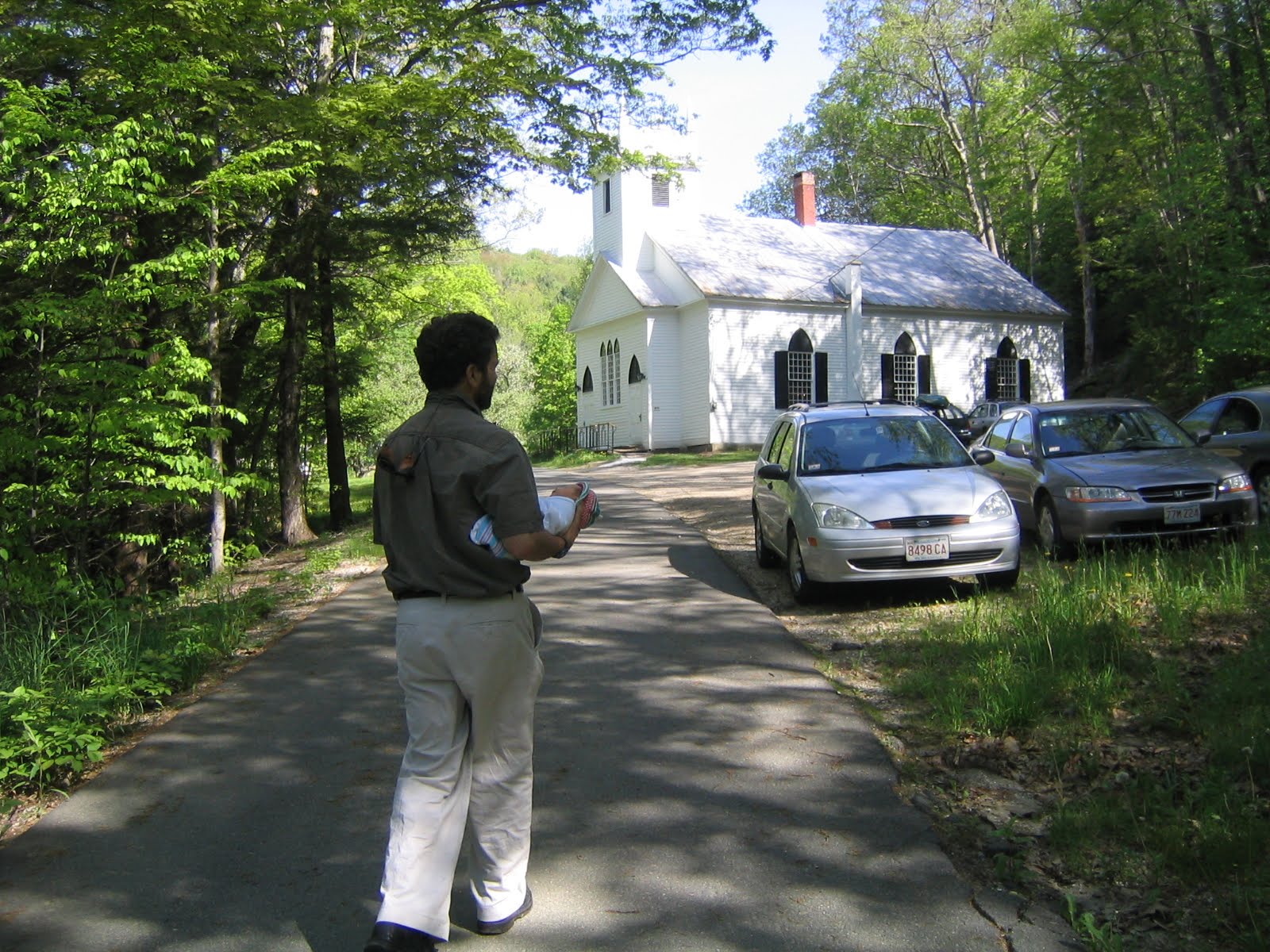
Tom carrying our 3-week-old up to our church on Arnold's birthday, May 2006


Site of the West Cummington Church which burned down on January 17

"The spiritual path wrecks the body and afterward restores it to health. It destroys the house to unearth the treasure, and with that treasure, builds it better than before"
RUMI


Today would have been Arnold Westwood's 89th birthday. I am remembering his infectious smile, his unflagging enthusiasm for our church, his love of the shoreline in Little Compton RI and his admonition to all of us a year ago at this time, when he preached his final sermon at the West Cummington Church, to "ignore exercise at your peril!" And I am thinking of him because this Saturday May 22 we are doing our annual gig at the West Cummington Church.

Except this year, there is no church standing in West Cummington. The church burned down on January 17. While the congregation has now officially voted to rebuild, and to rebuild on the site, in quite the style and manner of the old church with the addition of two very welcome bathrooms (there were none before, and parishioners had to walk a good seven minutes to the Parish House down the road), rebuilding is a long way off, and a big job. The show we are going to do this year is a benefit for this rebuilding. The Village Church in neighboring Cummington has been gracious enough to host us.

I have rarely looked forward more eagerly to a show. I can't wait to sing the new songs we have been accumulating since the fall. We plan to debut at least two new ones, and to fill the room with everything that's been brewing in our hearts for the past year. I for one am especially grateful to have back the use of my hands. I am typing this post, the first one I have been well enough to type since February when I was waylaid by Carpal Tunnel Syndrome (which I wrote about here). Like a person who wakes up after a two week flu feeling miraculously better, I stretch my wrists back and forth, amazed at the miraculous flexibility now achievable in those joints I used to take for granted. I can't wait to see my people on Saturday. I can't wait to sing with my sister. It's May. It's just over five years since I stood in a similar church and took my wedding vows with my husband Tom.


It's just over four years since my daughter was born. Arnold used to make a big birthday cake for all the May babies. When Elle was just fifteen days old, he added her (real) name to the cake.


I've been on a strict no-blogging diet as of late, as the rough draft of our book is due on our Shambhala editor's desk in a month. I am eating, drinking, breathing, sleeping The Musical Family. And this makes me think, of course, of The Sound of Music.

The Sound of Music is certainly (okay, probably) my all-time favorite musical, as it was the very first musical in which I was cast. I was 1977 and I was ten and in fifth grade. A big (literally) director named Calvin Remsberg came to my school to cast the seven Von Trapp children. I was one of those picked, and the experience was akin to dying and going to heaven, winning the lottery, the Grammy and the Oscar and getting chosen as number one on Todd Shey's Like List. My mother drove me to rehearsals every afternoon, and I got to hang out with gigantic, amazing teen-age girls at their fancy theatre while they in turn doted on me, called me "Marta" (my character's name--remember Marta? Second youngest.) I wore my long straight hair in two braids which the wardrobe lady curled under and fastened into large loops that resembled beagle ears (coincidentally, as a teenager, I wore those same long beagle braids in my role as Snoopy in You're a Good Man, Charlie Brown, on that same stage. But that's a whole other story.)

The musical was my first experience in a real play, with a real director (who has gone on to be a big shot--he stared in off Broadway productions of Cats as Old Deuteronomy and in Sweeney Todd...) But it was also my first experience fitting in with a group of people who seemed like my long lost tribe. I loved everything about the theatre. I loved the way the basement smelled, I loved the lights, I loved the way you could sit in the auditorium on seats that bounced up against their backs when you stood up, and the way you could drape your calves over the seat in front of you. I loved the make up, the costumes, memorizing my seven or eight lines "My name is Marta and I'm going to be seven on Tuesday, and I want a pink parasol." I loved my "siblings" and truly believed that they were my brothers and sisters. I loved learning, for the first time, about Austria in the Third Reich, and the evil Nazis and World War II and the Trapp Family Singers who now lived in Stowe VT. (I of course read all the biographies and autobiographies about Maria Von Trapp and how Howard Lindsay and Russel Crouse had changed many of the names of the kids in the staged musical.)

Most of all, I loved the music. I loved having a part to sing. I loved the choreography where we got to poke our heads out like cuckoos in a clock. I loved the way music saved Georg von Trapp from marrying the horrible baroness and instead fell in love with the lovable, unsolvable Maria. That story planted itself deep within my psyche--that music saves, that music is like the blood that runs through a family, connecting it, oxygenating it, renewing it, healing it, nurturing it.

And yet, believe it or not, I had never seen the Julie Andrews movie version until last week! How I managed to deprive myself of this pleasure, I don't quite know, except that I guess as a ten year old in 1977 it would have been challenging to watch it at will. This was pre-Beta Max, after all. Besides, someone I respected (most likely, Calvin Remsberg) had suggested that the staged Mary Martin version was far superior. So, loyal to a fault, I was given the LP soundtrack for Christmas that year, and that was good enough for me.

Anyway, I watched it over the course of the last week, which is pretty much the way I watch all movies lately. I only have about a half-hour a day, three days a week where watching a DVD is even possible: Mondays, Wednesdays and Fridays when Elle is at school and Jay is taking a nap. I sit in front of the TV, soaking my right hand in hot water and Epson salts and then icing it, while eating with my left hand. I let Elle watch the first half-hour, and while she liked it enough so that she makes me tell her the story every night at bath time, she does not want to actually watch it anymore. She thinks the dad is too scary.

I can relate. Marta's last line is "I'm scared." Looking back on this winter of losses (the church, my mother-in-law Mary Duffy and ––mercifully briefly–– my hands), I see how fear ran through these experiences in ways, though inevitable, were not helpful. As I wrote about the church, my first reaction was of pure horror: I had feared that the arsonist who had been responsible for multiple Northampton fires had a copycat in West Cummington. When I learned that the fire had been started by a faulty furnace, my fear turned to grief, and then hope and faith in our rebuilding efforts.


Debris from the fire a the West Cummington Church

My mother-in-law's death was harder, of course. But there was something in her full-out embrace of death, her passionate faith in her vision of being reunited with her late husband, that challenged me to my core ("cor" being the Latin root for "courage.") I am used to fighting illness, to taking every possible measure to "rage rage against the dying of the light." It was foreign to me to do otherwise, but for her sake, I let her go.


Tom, Mary Duffy and me in front of the West Cummington Church at our wedding rehearsal


Leaving me with a ton of excess fear I didn't know what to do with, and perhaps it went to my wrists. I will never know, but I do know this. One day about three weeks ago I made the decision not to believe that I needed surgery or shots. I made the decision to experience the pain as a kind of muscle ache, as the pain of growth, of childbirth, rather than the pain of injury, where to access the pain is to create damage. I was in a yoga class, with the intention to do a fully modified practice. But during the meditation at the beginning, I suddenly had the thought, "When I play the guitar, I think: this will hurt, but I will be okay. And I always am. I am going to take that attitude towards this yoga practice right now."

And so I did. And lo! I am healed. Yes, sometimes there is some stiffness, some slight pain, and yes, I am working organically on my posture and the ergodynamics of my writing situation, and no, I have not done a handstand yet (though I do a wicked pinchamayarasana), and I am madly in love with a product recommended to me by the fabulous Trina Hamlin called Traumeel (homeopathic anti-inflammatory cream that does not stink.) But I am not afraid. I am getting better.

Today I finished watching The Sound of Music. As the family crosses those Swiss alps, little Gretl on her father's shoulder's and Marta being guided gently by Maria, I wept. From the top of those alps is quite a view.

Wednesday, March 31, 2010

Where's The Lamb?

... Nothing, having arrived, will stay.
The earth, even, is like a flower, so soon
passeth it away. And yet this nothing
is the seed of all -- the clearer eye
of heaven, where all the worlds appear.
Where the imperfect has departed, the perfect
begins its struggle to return. The good gift
begins again its descent. The maker moves
in the unmade, stirring the water until
it clouds, dark beneath the surface, stirring and darkening the soul until pain
perceives new possibility. There is nothing
to do but learn and wait, return to work
on what remains. Seeds will sprout in the scar.
Though death is in the healing, it will heal.

Abridged from "The Slip" by Wendell Berry. North Point Press, 1987


I am writing this in the hopes that it might help somebody.

Right around the time our church burned down, I began looking at the calendar with a great deal of dread and trepidation. Every weekend, it seemed, for months and months, I was going to have to either board an airplane, drive miles and miles to a gig, or both. The sweet lull we'd experienced in December -- preserved to record our new CD and celebrate the holidays -- evaporated, as did the cozy, familial holiday cheer. Instead, there seemed a hard reality: as hard as the ground underneath the snow; as hard as the taste of ashes in our mouths as the result of our great loss.

Throughout this period of time, I clung to my yoga practice. There were stresses in my life, but aren't there always? Mastering arm balances -- those positions in yoga where one holds one's entire body above the earth through sheer willpower, prana and miracle; over 100 pounds of person balanced on tiny little wrists -- seemed to give me the strength I needed to get through the cold winter, through the crazy schedule, through the grief. But one day I noticed something: a pain in my right wrist. I ignored it.

And then, more bad news. Worse news, much worse. Tom's mother was diagnosed with pancreatic cancer. We got the bad news while in Florida, and for some reason, it was this that compelled me to tell Tom, "I think something’s wrong with my wrist." He, of course, urged me to get it checked out right away, and so when I returned home, I visited my primary care physician who in short order diagnosed me with carpal tunnel syndrome. I set about on my way, confident that I would conquer this quickly and be back on my hands in no time. I bought the dictation software, I diligently took ibuprofen, I bound my hands in wrist braces.

But it was February Album Writing Month. I don't know why, but the thought of not finishing those 14 songs and presenting them to the 36 or so people who read my blog seemed tantamount to death. A death of sorts, anyway. And so I finished the songs, made the videos, play the gigs, diapered my son, seat belted my children into their car seats even when they wriggled and kicked, bought the gigantic organic grapefruits and gallons of milk at the co-op, folded load upon load of laundry, and eventually began to drive back and forth along the Mass Pike to witness my mother-in-law readying herself to leave the world.

The pain got worse.

People  from all corners of my life called and e-mailed and made suggestions. I took them all, including the observation many offered that the pain was related to my stress. I became a keen observer of my body and its habits, and I began to notice that I have a nervous tick: when I am anxious, I furtively flick my thumbnail against my forefinger, which of course is exactly the repetitive motion that causes injury. So I tried to stop doing that.

Here are some of the other things I've tried: acupuncture with three different practitioners, positional therapy, modified yoga, mind over matter, as in just notice the pain but don’t believe it, occupational therapy, wrist braces, a thumb spica splint, the aforementioned ibuprofen but this time in gel caps, massage, Thai massage, vitamin B 6 and 12, a new ergo-dynamic mouse, a new ergo-dynamic office chair, a new ergo-dynamic keyboard, Feldenkrais, fish oil, the health-food version of Ben Gay, giving up all vegetables in the nightshade family, and begging off diapering my son whenever I see a willing substitute.

During this time, I have been meeting with a group of people from my church to study the book of Genesis. One night, we talked about the story of Abraham and Isaac, and how Abraham was told by God to sacrifice his longed-for son, finally born to his long-barren wife Sarah. In the story, father and son, along with two servants, journey three days to a mountain top. As they trudge along, Isaac asks Abraham, “Where is the lamb?”

“God will provide the lamb, my son,” says Abraham.

But Abraham's intention is to bind Isaac and kill him. It's the binding that really gets me. It's such a horrible thing Abraham does. Isaac is lying on top of the wood with his hands tied, and Abraham lifts the knife to slay him. At that point, the Bible says, an angel comes, and cries, “Stop! God sees that you fear him.”

And just then Abraham notices a ram stuck in the bushes, which he substitutes for Isaac.

I read this story as being about how messed up our ideas can get about how God wants us to be in the world. We can go drone-like into what we think is God's will for us. We make all sorts of decisions this way: over-working, marrying the guy we think we’re supposed to marry, having children when we think we’re supposed to have children, spending our weekend shopping and buying that new iPhone or whatever. And the only way I can make sense of the moment when Abraham puts down the knife is to think of the angel as internal to Abraham. Abraham's own inner angel wakes him up at that moment when he has the knife over his son and says, “Wait a second. Do you really want to be lead by fear? Can this really be God's will? There is a perfectly good ram suffering in the bushes over there. I think God would prefer I kill that ruminant to my son.”

And, after that, the angel says “Now Abraham, you are well blessed, your descendants will be as the stars in the sky or the sands in the earth.”

This is how we find our right lives. Not by the direction of some external God, telling us seemingly insane things that go against our hearts, but by listening to the voice of the angel.

I was on the verge of opting for surgery, speaking of knives. I was sick of waiting for my body to heal, tired of the mindfulness, the need to be so vigilant about my alignment and posture and ergo-everything. And then, right before meeting with an orthopedic surgeon, I got some information that rang true to my own experience--an inner angel communing with an outer one. I met with a physical therapist in Florence that several people have raved about. He quickly assessed my posture and pointed at That Spot between my shoulder blades which I wrote about last year at this time: the place of chronic pain and tension that many people share with me. (I think of you as my people. We of the hunch. We who use our arms to bring life toward us, rather than meeting it with our hearts.)

"See these wings you've got going on?" he said pointing at my scapulae which do indeed jut out in a rather alarming way. "These are like handles, lady. And feel these muscles in your neck. You have this little body, but a neck like a weight lifter’s." And, lying on the table, I felt him manipulate my neck, bringing it backwards in a way that I found both alarming, and somehow familiar. Like I was going back to an ancestral home.

After I saw this therapist, I went to an orthopedic surgeon. He gave me about 10 minutes of his time, spoke at about 1000 words a minute, and said that it would take many more tests to conclude this, but he was positive I did not have serious enough carpal tunnel syndrome to even consider me as a likely candidate for surgery. Instead he diagnosed me with something called DeQuervain's Tinosynovitis. (Just for the record, I am not against surgery. I still might have it, if the situation warrants. But everyone seems to be saying--even the surgeons--that I am many months away from a knife. I am hoping I can find a lamb.)

I'm trying not to make a big story about Nerissa out of all this, but I can't help it. The story goes like this, and I tell it here in part because this was such a large piece of my inspiration to blog last year at this time, and I feel embarrassed that I am once again in the same place: the place of having to admit that I work too hard. I love to work. Working gives me such pleasure, such a sense of self-importance and affirmation. I hate to say no to anything. I hate to say no to anybody. I feel as though my hands are telling me in the only way they know, "My dear. We need a rest."

One of my favorite treatments for whatever this condition might be is to soak my girls (I've been calling them my girls) in steaming hot water with a half a pound of Epsom salts, and then applying this cayenne cream all over my dry fingers, letting the heat sink in, and then putting the wrist braces back on and covering my hands with gloves, warm big soft mittens. I have stopped checking Facebook; I have stopped reading the New York Times or anything else online. I dictate all my e-mails. I don't read anything or respond to anything and less absolutely have to. Little by little, I am slowing down. Little by little, I am doing less. I've been noticing that it hurts to eat with a knife and fork, so I'm trying to find foods that are spoon-friendly, or that I can pick up and eat with my hands. I am buying pre-chopped frozen vegetables. I am having our milk delivered.

And I'm sitting on the couch and cuddling my daughter while she watches Mary Poppins, crying every time the dad has his epiphany and comes home, skips around the family room singing "Let's Go Fly a Kite.” I sang in church last Sunday, my hands hanging idly by my sides. I am working on opening my chest, opening my heart. I thought I had done this work years ago. Funny, how it always seems to be the same themes. Fear less, love more. Do less, be more.

"Is there hope for me?" This is what I ask every healer I visit. They always say yes, but many qualify that. The positional therapist I saw said, "Yes, but you're going have to give some things up. You can't play guitar and write and knit and garden. You have to choose." Well, of course we know what I will choose. But I grieve that bag of beautiful yarn that won't get turned into felted bags. I grieve the rosebush out front that won't get pruned. But aging is a process of loss and of losses. We become limited with every year that passes. I remember being heartbroken as a 10-year-old, when I realized it was too late for me to be the next Nadia Commenici. And in a way, that was a blessing: I was free to focus on what I really love to do, which was sing and play guitar. My girls have given me some pretty clear direction, and when I'm honest about it, they are answering a prayer I've been praying for the past year or so: give me clear direction about what I am supposed to do. In the past six weeks, I have not wasted my time poking (OW! painful!) around on my iPhone, or thinking of things to post on Twitter. I've been present for my husband, my son and daughter, my clients and writers, the book Katryna and I are writing. Things are pretty distilled right now. Plus, I have these fabulous divining rods attached to my body. Whenever I think or say something, I get an immediate gauge of its true usefulness to me. That fabulous Bible study has been way too much for us to commit to, and we recently made the decision to let it go. Actually that's a lie: the group decided to meet on Wednesday nights, and I have a writing group on Wednesday nights. Even though, I have no business trying to fit one more thing into my life, I found myself scheming about trying to convince the Bible group to move so that I could do both. When I said this out loud to a trusted friend, the nerves on my hands went zing zing zing! I laughed out loud. The body doesn't lie. My girls don't lie.

I have long suspected that the point of study and contemplation is not knowledge, but to become familiar and more comfortable with the not-knowing. So I can't know if this pain will go away. I hope it will, and I suspect it will. I hope to be playing the guitar for the rest of my life, to be writing many more books, to dance with my children at their weddings, and to be doing handstands in my 60s. But in the meantime, I see this... whatever it is... as a great teacher. I asked for a mindfulness teacher, and now I have one -- two in fact -- right here, on either side of my body. 

Tuesday, March 23, 2010

March 2010


I'm trying something new. I'm speaking rather than typing. Can one even call this writing? We'll see. As many of you know, I have carpal tunnel syndrome and an additional annoyance known as DeQuervian’s Tinosynovitis, a condition caused primarily by breastfeeding a large child while simultaneously “mousing” on a powerbook. In short, it hurts to type; the kind of hurt that is as much about the fear of making the injury worse as it is about the pain in itself.

I haven't written, really, since February. And even then, all I did was videotape my new songs and post them. I haven't really written anything since the church burned down.

The church burning down -- that seems like a different age. Since then, the seasons changed dramatically in more ways than one. On February 9, my mother-in-law Mary Duffy got a flat tire and ended up having to walk a mile into town to get help. She was hale and hardy, three weeks away from her birthday--I am sworn to secrecy about her age, but I will say it was a good round number. The next day, complaining of stomach pains, she was taken to the hospital. On the way she fielded a call on her beloved Bluetooth, which never left her ear. She was a realtor, and in the middle of an important sale. At one point during the conversation, her client said, "Mary, I'll have to call you back; I can’t hear you over that ambulance in the background. I'll wait until it dies down."

Mary, without missing a beat, said, "Oh no, honey. I’m in that ambulance."

Three days later, the doctors gave her the bad news: pancreatic cancer. One month to the day after that, on March 13, she died in a hospice in Natick Massachusetts. Oddly, I have had the word Natick on my calendar on March 13 for the past eight months. We were scheduled to perform at the Homegrown Coffeehouse in the Unitarian Universalist Church on Highland Avenue that night. Driving my husband in the pouring rain to his mother’s deathbed, I was on the verge of canceling the gig, but Tom said he needed to hear us sing. And knowing somewhere in my consciousness that music heals, I agreed.

At the concert, as per her daughter’s strict instructions (“Mimi wouldn’t have wanted you to cry”) we didn't say anything about my mother-in-law's passing until the end of the evening, when we did “Ain't That Good News, “ and got the entire audience to sing along with us on "Oh Mary Don't You Weep Don't You Mourn.” For the encore, even though it was still technically winter according to both the weather and the calendar, we sang the “May Day Carol” in honor of my mother-in-law’s gift for gardening.

Tom and I met in December 2003. I had recently been divorced and had spent the past couple of years dating lovely man that I just couldn't go the distance with. I realized that fall that I was never going to connect with anyone who didn't have some kind of a spiritual background. I didn't care if he was Muslim, Buddhist, Hindu, Jewish, or even a Jungian agnostic, as long as he was a seeker.

In his post on match.com, (yes, we really did meet on match.com) he wrote, "Here is something that's new for me: I've recently gone back to the Catholic Church. If this is a turn-off, read no further." Catholic? I could go with that. Even though I was raised Presbyterian and was becoming more and more convinced that my spiritual path was as Buddhist as it was Christian, I had great respect and love for the Catholicism modeled for me by my aunt Jenifer's husband Brian. It was Brian who gave to me for Christmas the year I was 16 a book by the Catholic priest Henri Nouwen. The book was a kind of meditation on prayer, as much about the black-and-white photographs of Amsterdam and her people as it was about God, and I was moved by this book so deeply that I vowed to follow Father Nouwen to the place where he was purported to be according to the information on the book jacket: Yale University.

Anyway, I winked at Tom, he asked me out for coffee, and the rest is history. For the first few months of our courtship, we attended St. Mary's Catholic Church in Northampton, a church he had found through another strange connection. Interested in his mother's devotion to this new group called Voices of the Faithful Tom, at the time a journalist for People Magazine, tagged along with her to some of their meetings, and in the process became hooked himself. He did a radio piece on Voices for WFCR and received a phone call shortly after from a woman named Ann Turner. Ann had hunted him down, and when she got him on the phone, said, "You must come to church with me and my family."

For a few months, I thought it might be in my future to convert to Catholicism. But it was 2004, and Massachusetts had just legalized gay marriage. Our priest began to make noises about this, and that was that. Tom and I discovered our sweet little Congregational-cum-Taoist church in West Cummington, where the minister wore a gigantic button that read, "Marriage is for Everyone."

But I still maintain great love and respect for Catholics, for Thomas Merton, the Berrigan Brothers and all my dear friends who believe, if not for the institutionalized church itself. And I knew that my mother-in-law sang in the choir at St. John's in Wellesley, continued to support Voices of the Faithful through all sorts of activities, including everything from marching with them to organizing paperwork. When I asked her about her spiritual life during those last weeks, she said, "Oh, I speak with Sister Evelyn all the time. She's wonderful. God is so good to me, Nerissa." So when Tom found out that the priest—Fr. TomPotter-- who had been so instrumental in supporting Voices of the Faithful would only be available to conduct the funeral on Wednesday, March 17 -- better known as St. Patrick's Day -- and his sisters protested, in part because they would have to reschedule a caterer (no small feat in the Boston area on St. Patrick's Day), he went to bat for Sr. Evelyn and Fr. Tom.
I happen to mention this on the phone to my aunt Jenifer and my uncle Brian, as part of my conversation with them to let them know about Mary's death.

"Sr. Evelyn Lowen?" said Brian.

"I don't know her last name," I said.

"Sr. Evelyn Lowen and Fr. Potter for my spiritual advisors at Harvard!" said Brian. "They were there when Voices of the Faithful began, and they've been nurturing it along ever since. I'm sure it's the same people."

Hearing this, I had chills. I brought the telephone downstairs and confirmed with Tom that indeed Sr. Evelyn's last name was Lowen. And I remembered back to being a teenager, sitting around Brian and Jenifer's kitchen table, talking about liberation theology, Fr. Nouwen, Thomas Merton and my newfound faith. There are angels hovering ‘round, indeed.

Throughout this period of time-- the bullet train that is pancreatic cancer, the shock of losing a parent, the confusion about how to talk to my children about the loss of a grandmother--I have been buoyed by that faith that I discovered amid the black-and-white photos of modern day Dutch in prayer 25-odd years ago. I thank God -- the God of my understanding -- every day for connecting me to my husband, not just through the passions of our hearts and bodies, but by our shared desire to understand all these things, seen and unseen.

Mary died in the middle of a nor'easter. The wind howled as loudly as we did at the foot of her bed. On the day she was buried, the sun shone on the garden in her backyard, the garden she had spent over 40 years cultivating, the garden that is perhaps more purely her, more alive, than anything else she left behind. One of her daughters made sure that she was buried with her Bluetooth. When Lila asked me why people had to die, I pointed to the trees and bushes and flowers in her grandmother's garden. "See those trees? And see the way the land rises over there? This whole garden, and all the trees around here are alive because people and plants and animals died and their bodies went into the ground to feed and support new trees and plants and people and animals. That's how it all works. We take turns."

Also I told her that her grandmother was up in heaven reunited with her grandpa. Because that's what Mary would've wanted me to say. That's what Mary believed: in fact, a week or so before she died, she told my parents that she thought we'd all meet again in heaven. "And if I'm wrong... I'm going to be really angry."

It's what I want to believe, too. I miss you, Mary. We are going to meet again in the kingdom. That's good news.

Monday, March 01, 2010

FAWM #8 Ten Year Tin

Possibly one of the most self-indulgent videos ever made, but here it is. Since recording this demo, we've decided to raise the key and we've messed with the arrangement quite a bit. Once again, the inspiration as well as the title, first line of the chorus and last line of the chorus are Katryna's. She and Dave celebrated their tenth last September.

Saturday, February 27, 2010

FAWM #7: Save A Tree

I have written all 14 songs, but now I have to record them and somehow present them here. Some are more challenging to do this with than others. Here is a co-write with my three and a half year old daughter.

Tuesday, February 23, 2010

FAWM #6: Hammurabi

FAWM #5 Henry the VIII of England

Henry the eighth was a Renaissance man
He brandished a chicken leg in his hand
He had 6 wives-why? “Because I can!”
Said Henry the 8th of England

You might think that’s enough to know
(Having six wives is unusual)
But I’m here to say “Not so!
There’s more to learn at Nields School.”

Henry fell in love with Ann Bolyn
Because her beauty was unsurpassed
So he tried to fire his first wife Catherine
The Catholic church said Not so fast

Said Henry to the Pope, Dear vecegerent
I have no use for your command
I declare myself (without your consent)
Defender of the Faith of the new Church of England
Or Inventor of the Church of England

You might think that’s enough to know
(Inventing a religion is unusual)
But I’m here to say “Not so!
There’s more to learn at Nields School.”

So Catherine he divorced though before he did
She gave birth to Mary, his first little kid
And Ann was mother to Elizabeth
Which should have been enough to prevent her death

But Henry really wanted a son
To make his surname last forevermore
He said to Ann Bolyn, You’re done!
And married poor jane Seymour

You might think that’s enough to know
(Beheading your wife is unusual)
But I’m here to say “Not so!
There’s more to learn at Nields School.”

Jane gave birth to weak little Edward
But then she died.
This got to Henry and his heart so hard
So he cried.

Then he married Anne from Germany
HE referred to her as the Flanders Mare
He married young Kathryn who was just nineteen
But for his old self she did not care.

She was beheaded like Ann Bolyn
Henry picked another Katherine
This time his wife outlived him
And married his brother-in-law.
Nerissa Nields Feb. 9, 2010


FAWM #4: I Just Want to Spend the Day with You

Wrote this on the plane coming home from Florida after we spent a lovely couple of days there with my parents. This song is supposed to be from the POV of grandparents. I recorded the video in the dressing room of the Me& Thee Coffeehouse in Marblehead MA. Guitar is c/o Seth Glier. I'd done the thing I've joked I'd do since giving birth to my first child: I remembered the breast pump and forgot the guitar.
Each verse is supposed to begin with "Bow Bow Bow" which is Jay's favorite part of the song, but I forgot to do that in the video.


Bow bow bow We go to the beach
Where the tide is red
Sandwiches to eat
We eat sand instead
I don’t care at all
Red tide can’t make me blue
I just want to spend the day with you

We go to the zoo
On a rainy day
See a kinkajoo
The tiger is hiding away
I don’t care at all
If the monkeys are hiding too
I just want to spend the day with you.

It’s not like everyday we get together
Talking on the phone or getting a letter
Is really great, but holding you is better
So who cares about a little thing like the weather?

We go to the park
Ride the Merry go round
Storm clouds make it dark
Too soon we’re homeward bound
I don’t care at all
No matter what we do
I just want to spend the day with you.


We go to the museum
To see the lilies by Monet
But no one’s there to see ‘em
We came on a quiet Monday
I don’t care at all
It the TV is all we view
I just want to spend the day with you.

Nerissa Nields
Feb. 17, 2010


Saturday, February 20, 2010

FAWM #3: Monday Moonday


Monday Moonday let's hope it's a sunny day
Everything begins on Monday

Tuesday Mars Day, red hot in the stars day
Maybe I will play with Lars today

Wednesday is the day we talk no matter what the weather
Thursday is HooteNanny when we sing together

Friday, a busy day, move so fast I'm dizzy day
Saturday the biggies go out for date night

And Sunday is when
We see all our friends
Stand on our heads
And put our plans to bed
And start all over again.

Tuesday, February 09, 2010

FAWM #2: Crazy Rider

This is "Ride a Cock Horse" meets the B-52s. The trick is to hold the child's feet as you bounce him/her so as to approximate a bucking bronco-type ride.